蝮 (fù) means "Viper (character component)" in Chinese. It has 15 strokes with the radical 虫.
Rated 4.2/5 in difficulty (advanced).
Appears in 3+ common words including 蝮蛇 (fù shé), 蝮蛇毒 (fù shé dú), 小蝮蛇 (xiǎo fù shé).
Due to its 15 strokes, Hanzi Writer's error detection shows 蝮 requires focused practice — most learners need 10+ attempts for consistent accuracy.
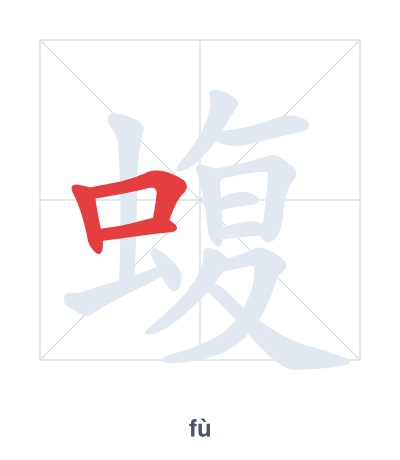
Open Hanzi Writer to see the animated stroke order and practice writing 蝮 with real-time feedback.
The character 蝮 (fù) is written with 15 strokes. Follow the standard Chinese stroke order: top to bottom, left to right, outside before inside. The radical 虫 is one of its key components.
Practice the correct stroke order with the Hanzi Writer app to see animated stroke-by-stroke guidance with real-time feedback.
蝮 means Viper (character component).
蝮 is a phono-semantic compound: the radical 虫 indicates it is a reptile or snake, and 复 (fù) provides the pronunciation, possibly also hinting at the repeated, coiling movement of a viper. This character specifically refers to a venomous viper, a type of dangerous snake.
💡 Memory Tip: Picture a viper (虫) that repeatedly (复) coils and strikes with its venomous fangs.
山里有很多蝮蛇。
shān lǐ yǒu hěn duō fù shé
There are many pit vipers in the mountains.
这种药含有蝮蛇毒。
zhè zhǒng yào hán yǒu fù shé dú
This medicine contains pit viper venom.
草丛里钻出一条小蝮蛇。
cǎo cóng lǐ zuān chū yī tiáo xiǎo fù shé
A small viper crawled out of the grass.
Open Hanzi Writer to see the animated stroke order and practice writing 蝮 with real-time feedback.
✨ Animated stroke order · Handwriting recognition · HSK-graded practice · Free to use
The character 蝮 is composed of the radical 虫 (meaning insect or reptile) on the left, and the phonetic component 复 on the right. The radical 虫 indicates that this character refers to a type of reptile, specifically a viper, while 复 provides the pronunciation fù and does not add to the meaning.