瞓 (fèn) means "To sleep (Cantonese)" in Chinese. It has 15 strokes with the radical 目.
Rated 4.2/5 in difficulty (advanced).
Appears in 3+ common words including 瞓觉 (fèn jué), 瞓醒 (fèn xǐng), 瞓得好 (fèn dé hǎo).
Due to its 15 strokes, Hanzi Writer's error detection shows 瞓 requires focused practice — most learners need 10+ attempts for consistent accuracy.
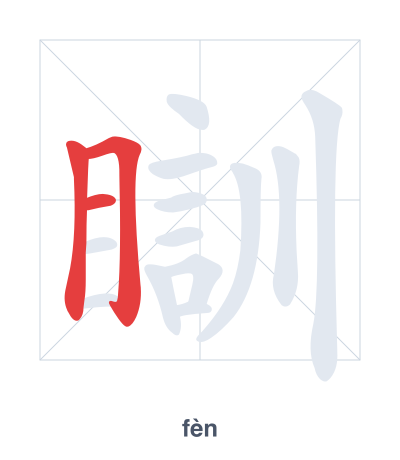
Open Hanzi Writer to see the animated stroke order and practice writing 瞓 with real-time feedback.
The character 瞓 (fèn) is written with 15 strokes. Follow the standard Chinese stroke order: top to bottom, left to right, outside before inside. The radical 目 is one of its key components.
Practice the correct stroke order with the Hanzi Writer app to see animated stroke-by-stroke guidance with real-time feedback.
瞓 means To sleep (Cantonese).
瞓 combines the radical 目 (eye) with 訓 (xùn 'to instruct') as a phonetic component. In Cantonese it means 'to sleep,' evoking the image of eyes closing as if being trained to rest. The character visually suggests the act of shutting one's eyes for sleep.
💡 Memory Tip: Imagine an eye (目) being gently trained (訓) to close—like a bedtime story lulling it to sleep.
他去瞓觉了。
tā qù fèn jué le
He went to sleep.
我刚瞓醒。
wǒ gāng fèn xǐng
I just woke up.
我昨晚瞓得好。
wǒ zuó wǎn fèn dé hǎo
I slept well last night.
Open Hanzi Writer to see the animated stroke order and practice writing 瞓 with real-time feedback.
✨ Animated stroke order · Handwriting recognition · HSK-graded practice · Free to use
The character 瞓 is made of the radical 目 (eye) on the left and 訓 (to instruct) on the right. The eye radical connects to sleeping because we close our eyes when we sleep. The right side may hint at the pronunciation, though the character is used in Cantonese rather than Mandarin.