偾 (fèn) means "To ruin / To fail" in Chinese. It has 11 strokes with the radical 亻.
Rated 3.9/5 in difficulty (challenging).
Appears in 3+ common words including 偾事 (fèn shì), 偾张 (fèn zhāng), 偾兴 (fèn xīng).
Due to its 11 strokes, Hanzi Writer's error detection shows 偾 requires focused practice — most learners need 10+ attempts for consistent accuracy.
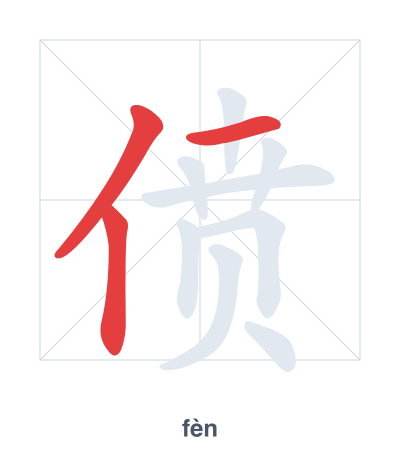
Open Hanzi Writer to see the animated stroke order and practice writing 偾 with real-time feedback.
The character 偾 (fèn) is written with 11 strokes. Follow the standard Chinese stroke order: top to bottom, left to right, outside before inside. The radical 亻 is one of its key components.
Practice the correct stroke order with the Hanzi Writer app to see animated stroke-by-stroke guidance with real-time feedback.
偾 means To ruin / To fail.
The character combines the radical 亻 (person) with 贲 (to rush, to burst forth), suggesting a person who rushes headlong into action, inevitably causing ruin or failure.
💡 Memory Tip: Imagine a person (亻) stamping on a precious shell (贝) hidden in grass (艹), shattering it into ruin (偾).
骄傲容易偾事。
jiāo ào róng yì fèn shì
Arrogance easily leads to failure.
他气得血管偾张。
tā qì dé xuè guǎn fèn zhāng
He was so angry that his veins were bulging.
事业正在偾兴。
shì yè zhèng zài fèn xīng
The career is flourishing and rising.
Open Hanzi Writer to see the animated stroke order and practice writing 偾 with real-time feedback.
✨ Animated stroke order · Handwriting recognition · HSK-graded practice · Free to use
The character 偾 is composed of the radical 亻 (person) on the left and the phonetic component 贲 (bì) on the right. The person radical suggests human action, while the sound 贲 hints at pronunciation; together they create the meaning of a person causing ruin or failure. This structure follows a common pattern where a radical indicates the general category and the other part provides sound or nuance.