榧 (fěi) means "Torreya" in Chinese. It has 14 strokes with the radical 木.
Rated 4.2/5 in difficulty (advanced).
Appears in 3+ common words including 香榧 (xiāng fěi), 榧子 (fěi zi), 榧木 (fěi mù).
Due to its 14 strokes, Hanzi Writer's error detection shows 榧 requires focused practice — most learners need 10+ attempts for consistent accuracy.
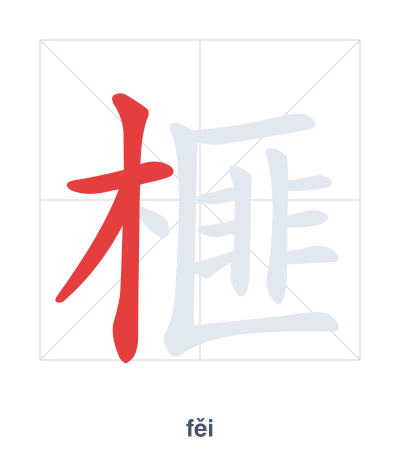
Open Hanzi Writer to see the animated stroke order and practice writing 榧 with real-time feedback.
The character 榧 (fěi) is written with 14 strokes. Follow the standard Chinese stroke order: top to bottom, left to right, outside before inside. The radical 木 is one of its key components.
Practice the correct stroke order with the Hanzi Writer app to see animated stroke-by-stroke guidance with real-time feedback.
榧 means Torreya.
榧 is a phono-semantic compound: the radical 木 (tree) indicates it is a type of tree, and the component 匪 (fěi, meaning 'bandit') provides the sound. The torreya tree produces edible seeds and is known for its durable wood, but the bandit component likely adds only pronunciation.
💡 Memory Tip: Picture a bandit (匪) climbing a tree (木) to steal torreya nuts, but he trips on a branch and the nuts rain down on his head.
香榧很好吃。
xiāng fěi hěn hǎo chī
Torreya nuts are very delicious.
榧子是干果。
fěi zi shì gān guǒ
Torreya nuts are dried fruits.
榧木可以做棋盘。
fěi mù kě yǐ zuò qí pán
Torreya wood can be used to make Go boards.
Open Hanzi Writer to see the animated stroke order and practice writing 榧 with real-time feedback.
✨ Animated stroke order · Handwriting recognition · HSK-graded practice · Free to use
榧 is made of the radical 木 (tree/wood) on the left and the phonetic component 匪 on the right. The 木 radical directly links the character to trees and wood. 匪 provides the sound (fěi) but also hints at the tree's value, as Torreya wood is prized for its durability and fragrance.