珐 (fà) means "Enamel (used in 'enamel')" in Chinese. It has 9 strokes with the radical 王.
Rated 4/5 in difficulty (challenging).
Appears in 3+ common words including 珐琅 (fà láng), 珐琅彩 (fà láng cǎi), 珐琅杯 (fà láng bēi).
Due to its 9 strokes, Hanzi Writer's error detection shows 珐 requires focused practice — most learners need 10+ attempts for consistent accuracy.
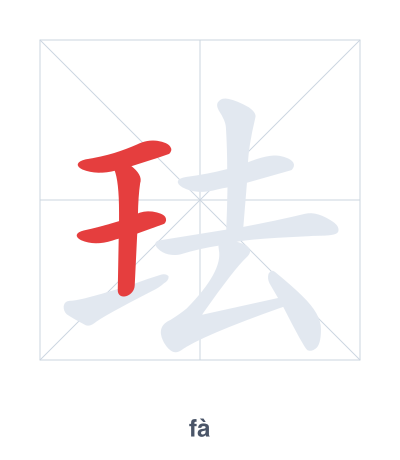
Open Hanzi Writer to see the animated stroke order and practice writing 珐 with real-time feedback.
The character 珐 (fà) is written with 9 strokes. Follow the standard Chinese stroke order: top to bottom, left to right, outside before inside. The radical 王 is one of its key components.
Practice the correct stroke order with the Hanzi Writer app to see animated stroke-by-stroke guidance with real-time feedback.
珐 means Enamel (used in 'enamel').
珐 is a compound character where the left radical 王 (jade) suggests the glossy, gem-like appearance of enamel, while the right component 法 (fǎ, 'law' or 'method') serves as a phonetic clue to the pronunciation fà.
💡 Memory Tip: Picture a jade king (王) using a strict legal method (法) to apply a shiny enamel coating to his crown.
这个珐琅盒很美。
zhè ge fà láng hé hěn měi
This enamel box is very beautiful.
珐琅彩颜色丰富。
fà láng cǎi yán sè fēng fù
Enamel colors are rich.
我买了一个珐琅杯。
wǒ mǎi le yí gè fà láng bēi
I bought an enamel cup.
Open Hanzi Writer to see the animated stroke order and practice writing 珐 with real-time feedback.
✨ Animated stroke order · Handwriting recognition · HSK-graded practice · Free to use
珐 is composed of the radical 王 (jade) on the left and the component 法 (fǎ, meaning "method" or "law") on the right. The jade radical suggests the shiny, precious quality of enamel, while 法 provides the pronunciation fà. Together they hint at a "jade-like substance made by a method," referring to the glassy coating of enamel.