缍 (duǒ) means "spindle / weight" in Chinese. It has 11 strokes with the radical 纟.
Rated 4.2/5 in difficulty (advanced).
Appears in 3+ common words including 线缍 (xiàn duǒ), 缍子 (duǒ zi), 丝缍 (sī duǒ).
Due to its 11 strokes, Hanzi Writer's error detection shows 缍 requires focused practice — most learners need 10+ attempts for consistent accuracy.
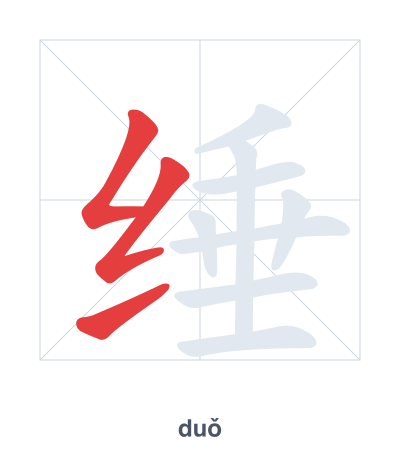
Open Hanzi Writer to see the animated stroke order and practice writing 缍 with real-time feedback.
The character 缍 (duǒ) is written with 11 strokes. Follow the standard Chinese stroke order: top to bottom, left to right, outside before inside. The radical 纟 is one of its key components.
Practice the correct stroke order with the Hanzi Writer app to see animated stroke-by-stroke guidance with real-time feedback.
缍 means spindle / weight.
The character 缍 combines the silk radical 纟 with 垂 (meaning 'to hang down'), forming a compound that depicts a hanging weight used in spinning thread. The silk radical indicates its connection to textile production, while 垂 illustrates the spindle's downward-hanging motion as it twists fibers.
💡 Memory Tip: Imagine a silk thread (纟) with a heavy stone (垂) tied to its end, spinning downward like a top to twist fibers into yarn.
桌上放着一个线缍。
zhuō shàng fàng zhe yí gè xiàn duǒ
There is a spindle on the table.
妈妈在用缍子绕线。
mā mā zài yòng duǒ zi rào xiàn
Mom is using a spindle to wind thread.
这是一个漂亮的丝缍。
zhè shì yí gè piào liàng de sī duǒ
This is a beautiful spindle.
Open Hanzi Writer to see the animated stroke order and practice writing 缍 with real-time feedback.
✨ Animated stroke order · Handwriting recognition · HSK-graded practice · Free to use
缍 is made of the radical 纟 (silk thread) on the left and 垂 (to hang or droop) on the right. The silk radical connects it to textiles, while 垂 suggests something hanging down, like a weight on a spindle. Together, they form the idea of a spindle or weight used in spinning thread.