垛 (duǒ) means "pile; stack; battlement" in Chinese. It has 9 strokes with the radical 土.
Rated 4/5 in difficulty (challenging).
Appears in 3+ common words including 垛子 (duǒ zi), 堆垛 (duī duǒ), 城垛 (chéng duǒ).
Due to its 9 strokes, Hanzi Writer's error detection shows 垛 requires focused practice — most learners need 10+ attempts for consistent accuracy.
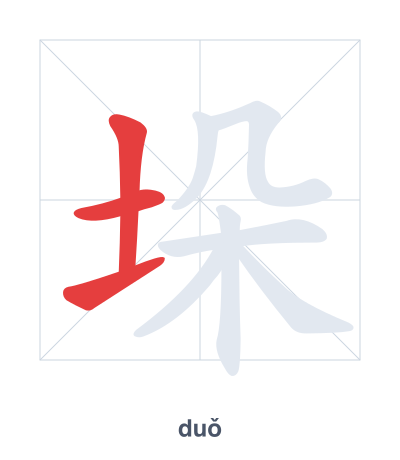
Open Hanzi Writer to see the animated stroke order and practice writing 垛 with real-time feedback.
The character 垛 (duǒ) is written with 9 strokes. Follow the standard Chinese stroke order: top to bottom, left to right, outside before inside. The radical 土 is one of its key components.
Practice the correct stroke order with the Hanzi Writer app to see animated stroke-by-stroke guidance with real-time feedback.
垛 means pile; stack; battlement.
垛 is a compound character combining the radical 土 (earth/dirt) with 朵 (duǒ, a classifier for flowers or clouds). The 朵 component provides phonetic clues and suggests something small and clustered, while 土 indicates the material; together, they depict a mound of earth piled up, which extended to mean a stack or the tooth-like projections of a battlement.
💡 Memory Tip: Picture a pile of dirt (土) shaped like a flower (朵) rising into a fortress wall's jagged battlement.
墙边有一个垛子。
qiáng biān yǒu yí gè duǒ zi
There is a buttress by the wall.
货物堆垛得很整齐。
huò wù duī duǒ dé hěn zhěng qí
The goods are stacked very neatly.
长城上有很多城垛。
cháng chéng shàng yǒu hěn duō chéng duǒ
There are many battlements on the Great Wall.
Open Hanzi Writer to see the animated stroke order and practice writing 垛 with real-time feedback.
✨ Animated stroke order · Handwriting recognition · HSK-graded practice · Free to use
垛 is made of the radical 土 (earth, soil) on the left, and the phonetic component 朵 (duǒ, meaning 'ear' or 'flower') on the right. Since 土 relates to earth or walls, and 朵 suggests a shape, together they form the idea of a pile of earth or a small wall structure like a battlement.