椟 (dú) means "Casket / case / box" in Chinese. It has 12 strokes with the radical 木.
Rated 4.2/5 in difficulty (advanced).
Appears in 3+ common words including 木椟 (mù dú), 买椟还珠 (mǎi dú huán zhū), 椟藏 (dú cáng).
Due to its 12 strokes, Hanzi Writer's error detection shows 椟 requires focused practice — most learners need 10+ attempts for consistent accuracy.
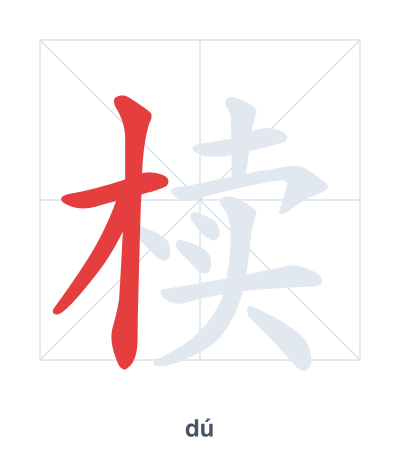
Open Hanzi Writer to see the animated stroke order and practice writing 椟 with real-time feedback.
The character 椟 (dú) is written with 12 strokes. Follow the standard Chinese stroke order: top to bottom, left to right, outside before inside. The radical 木 is one of its key components.
Practice the correct stroke order with the Hanzi Writer app to see animated stroke-by-stroke guidance with real-time feedback.
椟 means Casket / case / box.
椟 is a phono-semantic compound. The left radical 木 (wood) indicates that the casket or box is made of wood. The right component 卖 (simplified from 賣) provides the pronunciation dú, as seen in related characters like 读 (dú, to read).
💡 Memory Tip: Picture a wooden box (木) with a 'For Sale' sign (卖) on it, storing a precious casket inside.
这是一个精致的木椟。
zhè shì yí gè jīng zhì de mù dú
This is an exquisite wooden case.
别做买椟还珠的傻事。
bié zuò mǎi dú huán zhū de shǎ shì
Don't be foolish and show poor judgment.
他把宝物椟藏起来。
tā bǎ bǎo wù dú cáng qǐ lái
He hid the treasure in a box.
Open Hanzi Writer to see the animated stroke order and practice writing 椟 with real-time feedback.
✨ Animated stroke order · Handwriting recognition · HSK-graded practice · Free to use
椟 is made of two parts: the left radical 木 (wood/tree) and the right component 卖 (sell). The 木 radical shows that the character relates to wood or wooden objects, and the overall meaning is a wooden casket or box. Together, they suggest a wooden container used for storing valuables.