疸 (dǎn) means "jaundice" in Chinese. It has 10 strokes with the radical 疒.
Rated 4.2/5 in difficulty (advanced).
Appears in 3+ common words including 黄疸 (huáng dǎn), 疸症 (dǎn zhèng), 黄疸病 (huáng dǎn bìng).
Due to its 10 strokes, Hanzi Writer's error detection shows 疸 requires focused practice — most learners need 10+ attempts for consistent accuracy.
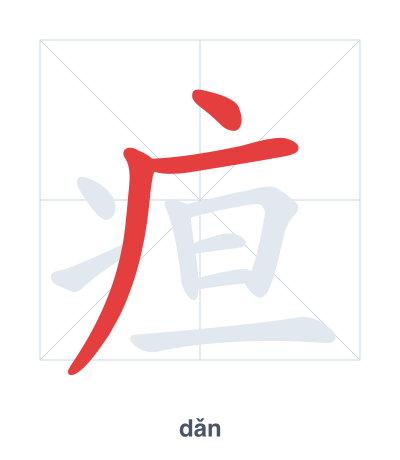
Open Hanzi Writer to see the animated stroke order and practice writing 疸 with real-time feedback.
The character 疸 (dǎn) is written with 10 strokes. Follow the standard Chinese stroke order: top to bottom, left to right, outside before inside. The radical 疒 is one of its key components.
Practice the correct stroke order with the Hanzi Writer app to see animated stroke-by-stroke guidance with real-time feedback.
疸 means jaundice.
The character 疸 combines the illness radical 疒 (depicting a person lying on a bed) with 旦 (dawn, showing the sun rising above the horizon). Jaundice is a disease that turns the skin yellow, reminiscent of the golden light of dawn.
💡 Memory Tip: Imagine a person (疒) with jaundice glowing yellow like the sun rising at dawn (旦).
婴儿容易得黄疸。
yīng ér róng yì dé huáng dǎn
Babies are prone to jaundice.
这种疸症很常见。
zhè zhǒng dǎn zhèng hěn cháng jiàn
This jaundice is very common.
他在治疗黄疸病。
tā zài zhì liáo huáng dǎn bìng
He is being treated for jaundice.
Open Hanzi Writer to see the animated stroke order and practice writing 疸 with real-time feedback.
✨ Animated stroke order · Handwriting recognition · HSK-graded practice · Free to use
The character 疸 is made of the radical 疒 (illness) on the outside, and 旦 (dàn, meaning dawn) inside. The radical 疒 shows that this character relates to disease, and 旦 provides the pronunciation clue dǎn. Together, they form the meaning "jaundice," a disease that affects the liver and skin.