跶 (da/dá) means "To stumble; to slip." in Chinese. It has 13 strokes with the radical 足.
Rated 4.2/5 in difficulty (advanced).
Appears in 3+ common words including 蹦跶 (bèng da), 溜跶 (liū dá), 跶了一跤 (dá le yī jiāo).
Due to its 13 strokes, Hanzi Writer's error detection shows 跶 requires focused practice — most learners need 10+ attempts for consistent accuracy.
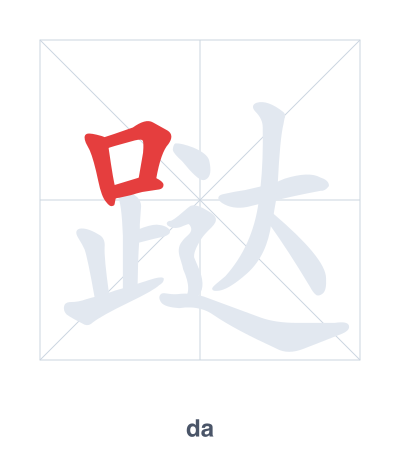
Open Hanzi Writer to see the animated stroke order and practice writing 跶 with real-time feedback.
The character 跶 (da/dá) is written with 13 strokes. Follow the standard Chinese stroke order: top to bottom, left to right, outside before inside. The radical 足 is one of its key components.
Practice the correct stroke order with the Hanzi Writer app to see animated stroke-by-stroke guidance with real-time feedback.
跶 means To stumble; to slip..
This is a polyphonic character with readings: da, dá.
The character 跶 combines the radical 足 (foot) with 达 (dá, meaning 'to reach' or 'arrive'). The foot radical indicates an action involving the feet, while 达 suggests movement toward a goal; thus, the compound conveys the idea of a foot reaching out awkwardly, resulting in a stumble or slip. This structural pairing reflects a misstep during movement toward an intended destination.
💡 Memory Tip: Picture a foot (足) trying to reach (达) a banana peel—it slips and stumbles comically.
别在那儿乱蹦跶。
bié zài nà ér luàn bèng da
Don't jump around over there.
我们去公园溜跶吧。
wǒ men qù gōng yuán liū dá ba
Let's take a stroll in the park.
他不小心跶了一跤。
tā bù xiǎo xīn dá le yī jiāo
He accidentally tripped and fell.
Open Hanzi Writer to see the animated stroke order and practice writing 跶 with real-time feedback.
✨ Animated stroke order · Handwriting recognition · HSK-graded practice · Free to use
跶 is formed by the radical 足 (foot) on the left and the phonetic component 达 (dá) on the right. The foot radical indicates the character relates to foot or leg actions, while 达 gives a clue to its pronunciation. Together they suggest unsteady foot movements like stumbling, hopping, or strolling.