荅 (dā) means "small bean / to answer (archaic)" in Chinese. It has 9 strokes with the radical 艹.
Rated 4/5 in difficulty (challenging).
Appears in 3+ common words including 荅子 (dā zi), 荅布 (dā bù), 荅然 (dā rán).
Due to its 9 strokes, Hanzi Writer's error detection shows 荅 requires focused practice — most learners need 10+ attempts for consistent accuracy.
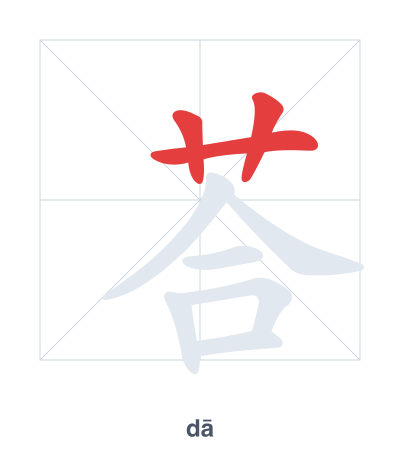
Open Hanzi Writer to see the animated stroke order and practice writing 荅 with real-time feedback.
The character 荅 (dā) is written with 9 strokes. Follow the standard Chinese stroke order: top to bottom, left to right, outside before inside. The radical 艹 is one of its key components.
Practice the correct stroke order with the Hanzi Writer app to see animated stroke-by-stroke guidance with real-time feedback.
荅 means small bean / to answer (archaic).
荅 combines the grass radical 艹 with 合 (hé, 'to join'), originally depicting a small bean plant. In ancient texts, it was also borrowed phonetically to mean 'to answer'.
💡 Memory Tip: Picture grass (艹) covering a box (合) of tiny beans; when you ask 'who's there?' the beans answer by popping out.
荅子是一种小豆子。
dā zi shì yī zhǒng xiǎo dòu zi
Dazi is a type of small bean.
这种布料叫荅布。
zhè zhǒng bù liào jiào dā bù
This fabric is called 'Dabu' (a type of coarse cloth).
他荅然若失地坐着。
tā dā rán ruò shī dì zuò zhe
He sat there looking dejected and lost.
Open Hanzi Writer to see the animated stroke order and practice writing 荅 with real-time feedback.
✨ Animated stroke order · Handwriting recognition · HSK-graded practice · Free to use
The character 荅 combines the radical 艹 (grass/plant) on top and 合 (to combine/match) below. The grass radical suggests plants, linking to the 'small bean' meaning, while 合 hints at the 'to answer' meaning since answering involves matching or responding.