嵯 (cuó) means "jagged / irregular" in Chinese. It has 12 strokes with the radical 山.
Rated 4.2/5 in difficulty (advanced).
Appears in 3+ common words including 嵯峨 (cuó é), 嵯嵯 (cuó cuó), 嵯峨山 (cuó é shān).
Due to its 12 strokes, Hanzi Writer's error detection shows 嵯 requires focused practice — most learners need 10+ attempts for consistent accuracy.
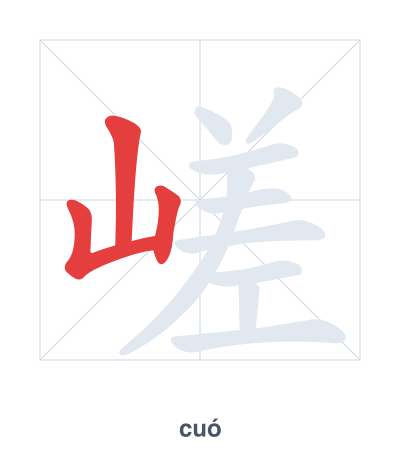
Open Hanzi Writer to see the animated stroke order and practice writing 嵯 with real-time feedback.
The character 嵯 (cuó) is written with 12 strokes. Follow the standard Chinese stroke order: top to bottom, left to right, outside before inside. The radical 山 is one of its key components.
Practice the correct stroke order with the Hanzi Writer app to see animated stroke-by-stroke guidance with real-time feedback.
嵯 means jagged / irregular.
嵯 is a compound character with the radical 山 (mountain) and the phonetic component 差 (cuó), which also means 'uneven' or 'irregular'. Together, the character depicts mountains that are jagged and uneven, emphasizing the rugged, irregular terrain.
💡 Memory Tip: Picture a mountain (山) so jagged that it looks like a sheep (羊) with a crooked tool (工) scraping its side, creating an irregular, uneven shape.
山势嵯峨险峻。
shān shì cuó é xiǎn jùn
The mountain is towering and precipitous.
嵯嵯怪石立路旁。
cuó cuó guài shí lì lù páng
Jagged, strange rocks stand by the roadside.
嵯峨山很有名。
cuó é shān hěn yǒu míng
Mount Cuoe is very famous.
Open Hanzi Writer to see the animated stroke order and practice writing 嵯 with real-time feedback.
✨ Animated stroke order · Handwriting recognition · HSK-graded practice · Free to use
嵯 is composed of the radical 山 (mountain) on top and 差 (difference, uneven) below. The mountain radical indicates the character relates to terrain, while 差 suggests irregularity, together forming the meaning 'jagged' or 'uneven' like a mountain range with sharp peaks.