邨 (cūn) means "Village" in Chinese. It has 6 strokes with the radical 阝.
Rated 2.9/5 in difficulty (moderate).
Appears in 3+ common words including 杏花邨 (xìng huā cūn), 邨屋 (cūn wū), 邨民 (cūn mín).
Hanzi Writer's stroke validation shows learners typically need 5-8 attempts to write 邨 with correct proportion and order.
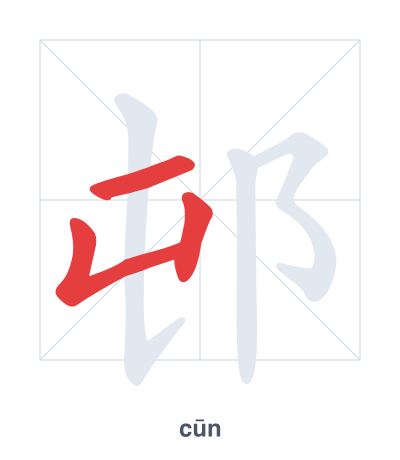
Open Hanzi Writer to see the animated stroke order and practice writing 邨 with real-time feedback.
The character 邨 (cūn) is written with 6 strokes. Follow the standard Chinese stroke order: top to bottom, left to right, outside before inside. The radical 阝 is one of its key components.
Practice the correct stroke order with the Hanzi Writer app to see animated stroke-by-stroke guidance with real-time feedback.
邨 means Village.
邨 combines 屯 (tún, meaning 'to gather' or 'store') and the right radical 阝 (a town or settlement), depicting a place where people gather together, forming a village. It is a historical variant of the more common character 村.
💡 Memory Tip: Picture a village with a storage shed (屯) at the edge of town (阝), where everyone gathers to store their harvest.
杏花邨在香港。
xìng huā cūn zài xiāng gǎng
Heng Fa Chuen is in Hong Kong.
他住在一间邨屋里。
tā zhù zài yī jiān cūn wū lǐ
He lives in a village house.
这里的邨民很友好。
zhè lǐ de cūn mín hěn yǒu hǎo
The villagers here are very friendly.
Open Hanzi Writer to see the animated stroke order and practice writing 邨 with real-time feedback.
✨ Animated stroke order · Handwriting recognition · HSK-graded practice · Free to use
邨 consists of the left radical 阝, which signifies a mound or place, and the right part 屯 (tún), which means to gather or a village. Together, 阝 (place) + 屯 (gathering) creates the idea of a village, a place where people gather. This structure is similar to the more common character 村, which uses 木 (tree) instead of 屯.