悤 (cōng) means "hurried" in Chinese. It has 11 strokes with the radical 心.
Rated 4.2/5 in difficulty (advanced).
Appears in 3+ common words including 悤悤 (cōng cōng), 悤忙 (cōng máng), 忧悤 (yōu cōng).
Due to its 11 strokes, Hanzi Writer's error detection shows 悤 requires focused practice — most learners need 10+ attempts for consistent accuracy.
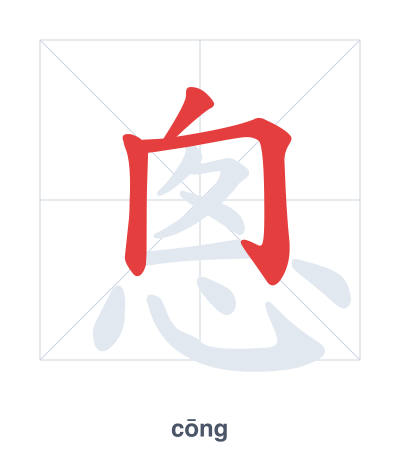
Open Hanzi Writer to see the animated stroke order and practice writing 悤 with real-time feedback.
The character 悤 (cōng) is written with 11 strokes. Follow the standard Chinese stroke order: top to bottom, left to right, outside before inside. The radical 心 is one of its key components.
Practice the correct stroke order with the Hanzi Writer app to see animated stroke-by-stroke guidance with real-time feedback.
悤 means hurried.
悤 combines the heart radical 心 with 囱, which originally depicted a window or chimney. The image suggests a heart rushing out like smoke through an opening, conveying the idea of urgency and haste.
💡 Memory Tip: Imagine a heart (心) so hurried it bursts through a window (囱) in a rush.
他悤悤地走了。
tā cōng cōng dì zǒu le
He left in a great hurry.
路上行人很悤忙。
lù shàng xíng rén hěn cōng máng
Pedestrians on the road are in a great hurry.
他内心感到忧悤。
tā nèi xīn gǎn dào yōu cōng
He felt anxious in his heart.
Open Hanzi Writer to see the animated stroke order and practice writing 悤 with real-time feedback.
✨ Animated stroke order · Handwriting recognition · HSK-graded practice · Free to use
悤 is made of two parts: the top part 囪 (cōng) gives the sound, and the bottom part 心 (xīn) means 'heart'. Together, they suggest a hurried or anxious feeling in one's heart.