Hanzi Writer

How to Write 龈 (kěn/yín) — Meaning “gums”

kěn/yín 14 strokes Radical: 齿

龈 (kěn/yín) means "gums" in Chinese. It has 14 strokes with the radical 齿.

Rated 4.2/5 in difficulty (advanced).

Appears in 3+ common words including 牙龈 (yá yín), 龈炎 (kěn yán), 牙龈肉 (yá yín ròu).

Due to its 14 strokes, Hanzi Writer's error detection shows 龈 requires focused practice — most learners need 10+ attempts for consistent accuracy.
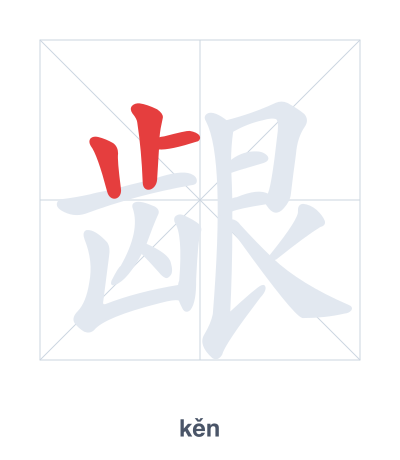
Stroke order practice for 龈 - kěn/yín

Practice Writing 龈 (kěn/yín)

Open Hanzi Writer to see the animated stroke order and practice writing 龈 with real-time feedback.

The character (kěn/yín) is written with 14 strokes. Follow the standard Chinese stroke order: top to bottom, left to right, outside before inside. The radical 齿 is one of its key components.

Practice the correct stroke order with the Hanzi Writer app to see animated stroke-by-stroke guidance with real-time feedback.

means gums.

This is a polyphonic character with readings: kěn, yín.

Character
Pinyinkěn / yín (ken/yin)
Meaninggums
Strokes14
Radical齿
Difficulty4.2/5

This compound character combines the 'teeth' radical (齿) on the left with 艮 (gèn) as a phonetic component. The gums are the soft tissue surrounding the teeth, so the radical directly ties to its meaning.

💡 Memory Tip: Imagine teeth (齿) biting into a root (艮) so hard that your gums (龈) get swollen and sore.

yá yín
gums
kěn yán
gingivitis; gum inflammation
yá yín ròu
gum tissue

我的牙龈出血了。

wǒ de yá yín chū xiě le

My gums are bleeding.

医生说我有龈炎。

yī shēng shuō wǒ yǒu kěn yán

The doctor said I have gingivitis.

牙龈肉红肿了。

yá yín ròu hóng zhǒng le

The gums are red and swollen.

Character Pinyin Strokes Radical
(current) kěn / yín 14 齿
13 齿
líng 13 齿
bāo 13 齿
Stroke order practice for 龈 - kěn/yín

Practice Writing 龈 (kěn/yín)

Open Hanzi Writer to see the animated stroke order and practice writing 龈 with real-time feedback.

✨ Animated stroke order · Handwriting recognition · HSK-graded practice · Free to use

Frequently Asked Questions about 龈

The character 龈 is left-right structured. The left part is 齿, meaning teeth, which gives the core meaning related to the mouth. The right part 艮 is a phonetic component that hints at the pronunciation kěn, though not exact.

Characters with Radical 齿

Other 14-Stroke Characters