埕 (chéng) means "Open space; yard." in Chinese. It has 10 strokes with the radical 土.
Rated 4.2/5 in difficulty (advanced).
Appears in 3+ common words including 盐埕 (yán chéng), 埕口 (chéng kǒu), 埕地 (chéng dì).
Due to its 10 strokes, Hanzi Writer's error detection shows 埕 requires focused practice — most learners need 10+ attempts for consistent accuracy.
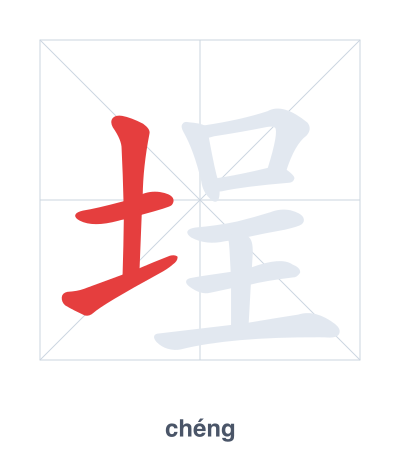
Open Hanzi Writer to see the animated stroke order and practice writing 埕 with real-time feedback.
The character 埕 (chéng) is written with 10 strokes. Follow the standard Chinese stroke order: top to bottom, left to right, outside before inside. The radical 土 is one of its key components.
Practice the correct stroke order with the Hanzi Writer app to see animated stroke-by-stroke guidance with real-time feedback.
埕 means Open space; yard..
埕 is a phono-semantic compound, with 土 (earth/ground) as the radical indicating its meaning of a flat area, and 呈 (chéng) as the phonetic component. Together they depict a level open space made of earth, like a yard or threshing ground. The character likely originated from agricultural settings where grain was laid out on a flat dirt surface.
💡 Memory Tip: Imagine a flat earthen yard (土) where you 'present' (呈) your harvest to dry in the sun.
这里是盐埕。
zhè lǐ shì yán chéng
This is a salt field.
船停在埕口。
chuán tíng zài chéng kǒu
The boat is stopped at the wharf entrance.
埕地很平坦。
chéng dì hěn píng tǎn
The open ground is very flat.
Open Hanzi Writer to see the animated stroke order and practice writing 埕 with real-time feedback.
✨ Animated stroke order · Handwriting recognition · HSK-graded practice · Free to use
埕 is composed of the radical 土 (earth) on the left and the phonetic component 呈 (chéng, meaning 'to present' or 'appear') on the right. The radical suggests the character relates to ground or land, and 呈 implies a flat, open area where something is displayed or laid out. Together, they form the meaning of an open space or yard, such as a salt pan.