岔 (chà) means "Fork; branch" in Chinese. It has 7 strokes with the radical 山, and is HSK Level 7.
Rated 3.5/5 in difficulty (challenging).
Harder than 17% of HSK Level 7 characters.
Appears in 3+ common words including 岔路 (chà lù), 打岔 (dǎ chà), 走岔 (zǒu chà).
Due to its 7 strokes, Hanzi Writer's error detection shows 岔 requires focused practice — most learners need 10+ attempts for consistent accuracy.
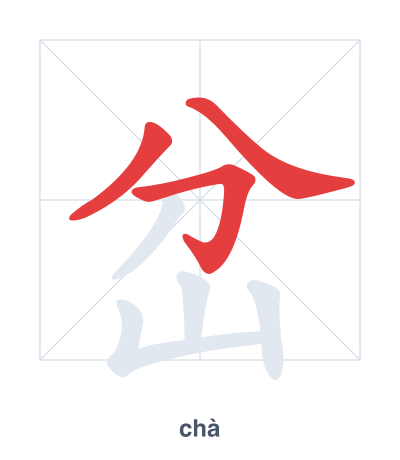
Open Hanzi Writer to see the animated stroke order and practice writing 岔 with real-time feedback.
The character 岔 (chà) is written with 7 strokes. Follow the standard Chinese stroke order: top to bottom, left to right, outside before inside. The radical 山 is one of its key components.
Practice the correct stroke order with the Hanzi Writer app to see animated stroke-by-stroke guidance with real-time feedback.
岔 means Fork; branch.
As an HSK Level 7 character, 岔 is an intermediate-level character.
岔 combines 分 (divide) on top and 山 (mountain) below, suggesting a mountain splitting into separate paths. The character visually represents a fork or branch, as a mountain that parts into two directions.
💡 Memory Tip: Picture a mountain (山) that is split in half (分) by a giant fork, creating two separate roads.
前面有一个岔路口。
qián miàn yǒu yí gè chà lù kǒu
There is a fork in the road ahead.
别打岔,让他说完。
bié dǎ chà ràng tā shuō wán
Don't interrupt, let him finish.
我们刚才走岔了。
wǒ men gāng cái zǒu chà le
We just took the wrong path.
Open Hanzi Writer to see the animated stroke order and practice writing 岔 with real-time feedback.
✨ Animated stroke order · Handwriting recognition · HSK-graded practice · Free to use
岔 is made of two parts: 分 (fēn, to divide) on top and 山 (shān, mountain) on the bottom. Together, they suggest a path dividing in a mountain area, which creates a fork or branch. This structure directly gives the character its core meaning of a split or side track.