漕 (cáo) means "Water transport of grain" in Chinese. It has 14 strokes with the radical 氵.
Rated 4.2/5 in difficulty (advanced).
Appears in 3+ common words including 漕运 (cáo yùn), 漕河 (cáo hé), 漕船 (cáo chuán).
Due to its 14 strokes, Hanzi Writer's error detection shows 漕 requires focused practice — most learners need 10+ attempts for consistent accuracy.
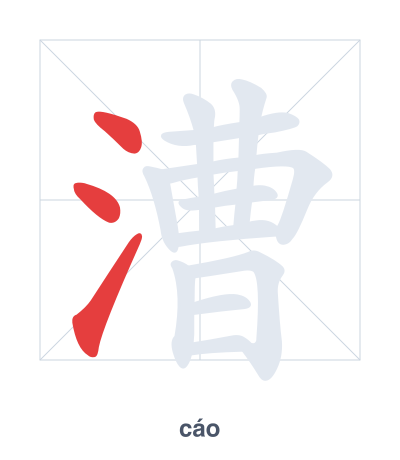
Open Hanzi Writer to see the animated stroke order and practice writing 漕 with real-time feedback.
The character 漕 (cáo) is written with 14 strokes. Follow the standard Chinese stroke order: top to bottom, left to right, outside before inside. The radical 氵 is one of its key components.
Practice the correct stroke order with the Hanzi Writer app to see animated stroke-by-stroke guidance with real-time feedback.
漕 means Water transport of grain.
漕 is a semantic-phonetic compound. The radical 氵 (water) indicates its connection to water transport, while 曹 (cáo) provides the sound. Together, they represent the movement of grain by canal or river.
💡 Memory Tip: Imagine water (氵) flowing past two stacked mouths (曰) in a grain storage (曹) as boats load up for transport.
古代的漕运很发达。
gǔ dài de cáo yùn hěn fā dá
Ancient water transport was very developed.
漕河的水很清。
cáo hé de shuǐ hěn qīng
The water in the grain canal is very clear.
漕船上装满了粮食。
cáo chuán shàng zhuāng mǎn le liáng shí
The grain boat is full of grain.
Open Hanzi Writer to see the animated stroke order and practice writing 漕 with real-time feedback.
✨ Animated stroke order · Handwriting recognition · HSK-graded practice · Free to use
漕 combines the water radical 氵 on the left with 曹 on the right. The water radical directly relates to the meaning of water transport, while 曹 provides the pronunciation and originally meant a 'group' or 'official' — together they suggest moving grain by water as an official activity.