窆 (biǎn) means "To lower a coffin into a grave." in Chinese. It has 9 strokes with the radical 穴.
Rated 4/5 in difficulty (challenging).
Appears in 3+ common words including 窆葬 (biǎn zàng), 下窆 (xià biǎn), 窆石 (biǎn shí).
Due to its 9 strokes, Hanzi Writer's error detection shows 窆 requires focused practice — most learners need 10+ attempts for consistent accuracy.
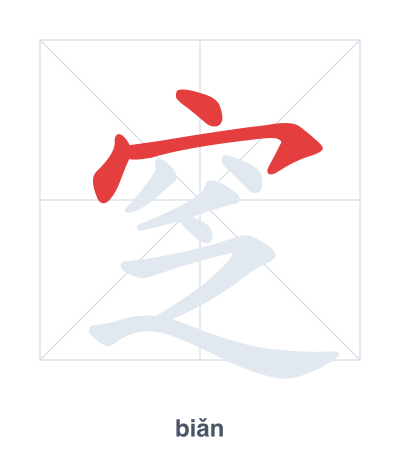
Open Hanzi Writer to see the animated stroke order and practice writing 窆 with real-time feedback.
The character 窆 (biǎn) is written with 9 strokes. Follow the standard Chinese stroke order: top to bottom, left to right, outside before inside. The radical 穴 is one of its key components.
Practice the correct stroke order with the Hanzi Writer app to see animated stroke-by-stroke guidance with real-time feedback.
窆 means To lower a coffin into a grave..
窆 combines the radical 穴 (cave/pit) representing the grave, with 乏 (biǎn) as a phonetic component. The structure evokes the act of lowering a coffin into a burial pit, with 乏 perhaps hinting at the 'lack' of life.
💡 Memory Tip: Picture a pit (穴) where workers lower a coffin with ropes that form the zigzag shape of 乏, looking tired from the heavy task.
举行窆葬仪式。
jǔ xíng biǎn zàng yí shì
To hold a burial ceremony.
择日下窆。
zé rì xià biǎn
To choose a date for burial.
墓前立有窆石。
mù qián lì yǒu biǎn shí
A stone tablet for lowering the coffin stands in front of the tomb.
Open Hanzi Writer to see the animated stroke order and practice writing 窆 with real-time feedback.
✨ Animated stroke order · Handwriting recognition · HSK-graded practice · Free to use
窆 has two parts: the radical 穴 (cave) on top, and 乏 (lacking or exhausted) below. The cave radical suggests a hole in the ground, which connects to a grave. The phonetic component 乏 hints at the sound "biǎn" but also carries the sense of something being lowered or put to rest.