阪 (bǎn) means "Slope or hillside." in Chinese. It has 6 strokes with the radical 阝.
Rated 2.9/5 in difficulty (moderate).
Appears in 3+ common words including 大阪 (dà bǎn), 阪田 (bǎn tián), 阪 (bǎn).
Hanzi Writer's stroke validation shows learners typically need 5-8 attempts to write 阪 with correct proportion and order.
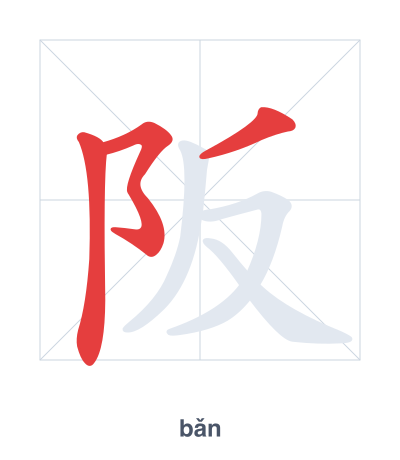
Open Hanzi Writer to see the animated stroke order and practice writing 阪 with real-time feedback.
The character 阪 (bǎn) is written with 6 strokes. Follow the standard Chinese stroke order: top to bottom, left to right, outside before inside. The radical 阝 is one of its key components.
Practice the correct stroke order with the Hanzi Writer app to see animated stroke-by-stroke guidance with real-time feedback.
阪 means Slope or hillside..
阪 combines the radical 阝, meaning a mound or hill, with 反, which depicts a hand turning over or reversing. Together, they suggest a hillside that slopes downward or a place where the hill 'turns' or reverses direction, creating a slope.
💡 Memory Tip: Picture a hill (阝) where a hand (反) is pushing you down the slope — you're about to take a tumble!
我要去大阪旅游。
wǒ yào qù dà bǎn lǚ yóu
I'm going to Osaka for a trip.
他姓阪田。
tā xìng bǎn tián
His surname is Sakata.
阪字和山坡有关。
bǎn zì hé shān pō yǒu guān
The character "bǎn" is related to hillsides.
Open Hanzi Writer to see the animated stroke order and practice writing 阪 with real-time feedback.
✨ Animated stroke order · Handwriting recognition · HSK-graded practice · Free to use
阪 is made of the radical 阝 (left ear, meaning hill) on the left and 反 (fǎn, meaning reverse or opposite) on the right. The hill radical suggests a landform, and the 反 component may indicate the sloping or turning nature of a hillside. Together, they form the meaning "slope" or "hillside."