扳 (bān) means "to pull; to turn; to wrench" in Chinese. It has 7 strokes with the radical 扌, and is HSK Level 7.
Rated 3.5/5 in difficulty (challenging).
Harder than 17% of HSK Level 7 characters.
Appears in 3+ common words including 扳手 (bān shǒu), 扳回 (bān huí), 扳动 (bān dòng).
Due to its 7 strokes, Hanzi Writer's error detection shows 扳 requires focused practice — most learners need 10+ attempts for consistent accuracy.
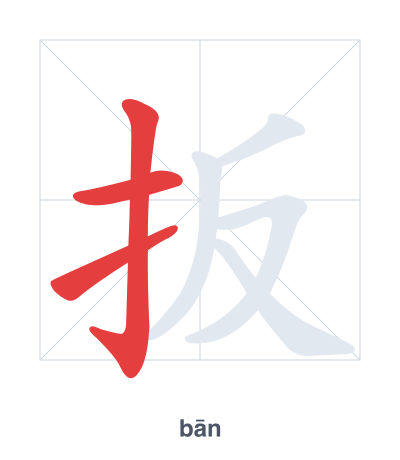
Open Hanzi Writer to see the animated stroke order and practice writing 扳 with real-time feedback.
The character 扳 (bān) is written with 7 strokes. Follow the standard Chinese stroke order: top to bottom, left to right, outside before inside. The radical 扌 is one of its key components.
Practice the correct stroke order with the Hanzi Writer app to see animated stroke-by-stroke guidance with real-time feedback.
扳 means to pull; to turn; to wrench.
As an HSK Level 7 character, 扳 is an intermediate-level character.
扳 is a compound character combining the hand radical 扌 (hand) with 反 (opposite/reverse). The hand (扌) performs a turning or pulling action, while 反 indicates the direction—pulling something in the opposite direction or turning it over. The character visually suggests using your hand to reverse or turn something.
💡 Memory Tip: Imagine your hand (扌) grabbing a lever and yanking it the opposite way (反) to wrench it free.
我用扳手修车。
wǒ yòng bān shǒu xiū chē
I use a wrench to fix the car.
我们扳回了比分。
wǒ men bān huí le bǐ fēn
We evened the score.
轻轻扳动把手。
qīng qīng bān dòng bǎ shǒu
Gently pull the handle.
Open Hanzi Writer to see the animated stroke order and practice writing 扳 with real-time feedback.
✨ Animated stroke order · Handwriting recognition · HSK-graded practice · Free to use
The character 扳 is made of the radical 扌 (hand) on the left, showing the action is done with the hand. On the right is 反 (fǎn), which means "to turn" or "opposite," hinting at turning or pulling something in the opposite direction. Together, hand + turning gives the sense of pulling or wrenching an object.