遨 (áo) means "To roam; to travel." in Chinese. It has 13 strokes with the radical 辶.
Rated 4.2/5 in difficulty (advanced).
Appears in 1+ common words including 遨游 (áo yóu).
Due to its 13 strokes, Hanzi Writer's error detection shows 遨 requires focused practice — most learners need 10+ attempts for consistent accuracy.
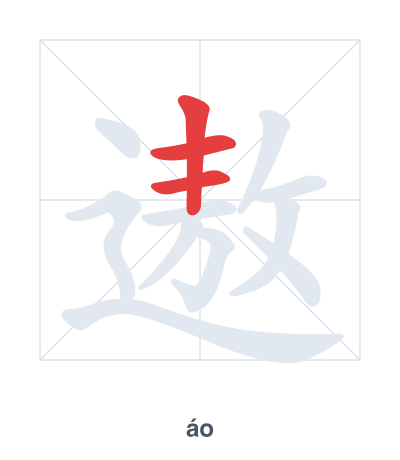
Open Hanzi Writer to see the animated stroke order and practice writing 遨 with real-time feedback.
The character 遨 (áo) is written with 13 strokes. Follow the standard Chinese stroke order: top to bottom, left to right, outside before inside. The radical 辶 is one of its key components.
Practice the correct stroke order with the Hanzi Writer app to see animated stroke-by-stroke guidance with real-time feedback.
遨 means To roam; to travel..
遨 is a compound character combining the radical 辶 (walking) with the phonetic component 敖 (áo, meaning 'proud' or 'arrogant'). The character originally signified moving freely and proudly, evolving to mean roaming or traveling without a fixed destination.
💡 Memory Tip: Picture a proud peacock (敖) striding majestically (辶) as it roams through a vast landscape.
我们在知识的海洋遨游。
wǒ men zài zhī shí de hǎi yáng áo yóu
We are roaming in the ocean of knowledge.
宇航员在太空遨游。
yǔ háng yuán zài tài kōng áo yóu
Astronauts are traveling in space.
鱼儿在水里自由遨游。
yú ér zài shuǐ lǐ zì yóu áo yóu
The fish swim freely in the water.
Open Hanzi Writer to see the animated stroke order and practice writing 遨 with real-time feedback.
✨ Animated stroke order · Handwriting recognition · HSK-graded practice · Free to use
遨 consists of the radical 辶 (walk) on the left, indicating movement, and the phonetic component 敖 on the right. 敖 itself suggests "rambling" or "proudly going", so together they create the idea of freely roaming or traveling without restriction.