瑷 (ài) means "Fine jade" in Chinese. It has 14 strokes with the radical 王.
Rated 4.2/5 in difficulty (advanced).
Appears in 3+ common words including 瑷珲 (ài huī), 瑷瑷 (ài ài), 瑷珲条约 (ài huī tiáo yuē).
Due to its 14 strokes, Hanzi Writer's error detection shows 瑷 requires focused practice — most learners need 10+ attempts for consistent accuracy.
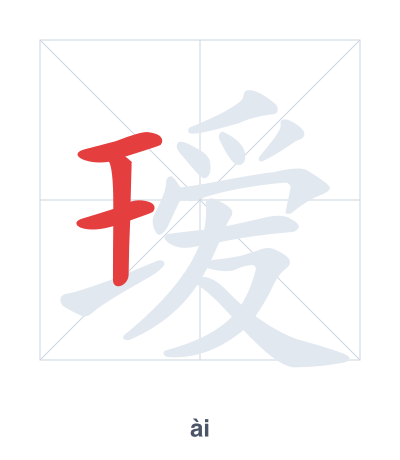
Open Hanzi Writer to see the animated stroke order and practice writing 瑷 with real-time feedback.
The character 瑷 (ài) is written with 14 strokes. Follow the standard Chinese stroke order: top to bottom, left to right, outside before inside. The radical 王 is one of its key components.
Practice the correct stroke order with the Hanzi Writer app to see animated stroke-by-stroke guidance with real-time feedback.
瑷 means Fine jade.
瑷 is a phono-semantic compound with the jade radical 王 (a variant of 玉) indicating the meaning 'jade,' and 愛 (ài, 'love') serving as the phonetic component. Together, they suggest a fine or precious jade that is cherished like a loved one.
💡 Memory Tip: Imagine a king (王) offering a piece of jade to his beloved (愛), making it a truly fine jade (瑷).
瑷珲是一个历史地名。
ài huī shì yí gè lì shǐ dì míng
Aihun is a historical place name.
这里的玉石色泽瑷瑷。
zhè lǐ de yù shí sè zé ài ài
The jade here has a cloudy luster.
我们学习了瑷珲条约。
wǒ men xué xí le ài huī tiáo yuē
We studied the Treaty of Aigun.
Open Hanzi Writer to see the animated stroke order and practice writing 瑷 with real-time feedback.
✨ Animated stroke order · Handwriting recognition · HSK-graded practice · Free to use
The character 瑷 combines the radical 王 (jade) on the left with the phonetic component 爱 (ài, love) on the right. The radical 王 indicates that the character relates to jade or precious stones, while 爱 provides the pronunciation. Together, they form the meaning 'fine jade.'