琚 (jū) means "Ornamental gem" in Chinese. It has 12 strokes with the radical 王.
Rated 4.2/5 in difficulty (advanced).
Appears in 3+ common words including 琼琚 (qióng jū), 佩琚 (pèi jū), 琚瑀 (jū yǔ).
Due to its 12 strokes, Hanzi Writer's error detection shows 琚 requires focused practice — most learners need 10+ attempts for consistent accuracy.
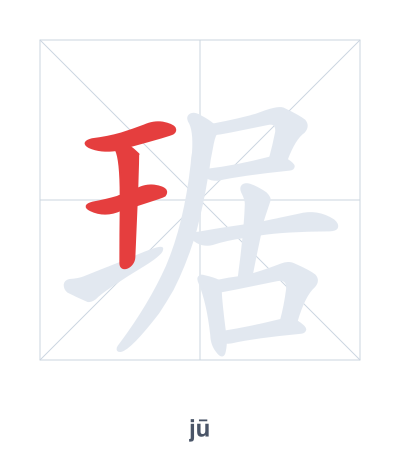
Open Hanzi Writer to see the animated stroke order and practice writing 琚 with real-time feedback.
The character 琚 (jū) is written with 12 strokes. Follow the standard Chinese stroke order: top to bottom, left to right, outside before inside. The radical 王 is one of its key components.
Practice the correct stroke order with the Hanzi Writer app to see animated stroke-by-stroke guidance with real-time feedback.
琚 means Ornamental gem.
琚 is a phono-semantic compound where 王 (jade radical) indicates the gemstone meaning, and 居 (jū, 'dwell' or 'reside') provides the pronunciation. The character refers to an ornamental gem worn as a pendant or adornment, often jade.
💡 Memory Tip: A jade ornament (王) sits at home (居) as your precious decorative gem.
他送给我一块琼琚。
tā sòng gěi wǒ yī kuài qióng jū
He gave me a piece of fine jade.
古人身上带着佩琚。
gǔ rén shēn shàng dài zhe pèi jū
Ancient people wore jade pendants on their bodies.
这些琚瑀闪闪发光。
zhè xiē jū yǔ shǎn shǎn fā guāng
These gems are sparkling.
Open Hanzi Writer to see the animated stroke order and practice writing 琚 with real-time feedback.
✨ Animated stroke order · Handwriting recognition · HSK-graded practice · Free to use
The left side is 王, the radical for jade or gem. The right side is 居, which gives the pronunciation jū. Together, 琚 means an ornamental gem, as the jade radical indicates a precious stone and the character is used to name types of fine jade ornaments.