俎 (zǔ) means "sacrificial vessel; chopping block" in Chinese. It has 9 strokes with the radical 人.
Rated 3.7/5 in difficulty (challenging).
Appears in 3+ common words including 俎上 (zǔ shàng), 俎豆 (zǔ dòu), 越俎代庖 (yuè zǔ dài páo).
Due to its 9 strokes, Hanzi Writer's error detection shows 俎 requires focused practice — most learners need 10+ attempts for consistent accuracy.
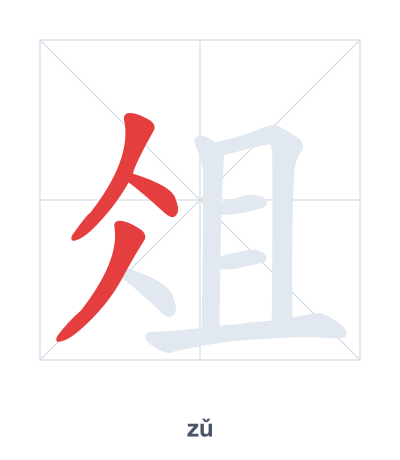
Open Hanzi Writer to see the animated stroke order and practice writing 俎 with real-time feedback.
The character 俎 (zǔ) is written with 9 strokes. Follow the standard Chinese stroke order: top to bottom, left to right, outside before inside. The radical 人 is one of its key components.
Practice the correct stroke order with the Hanzi Writer app to see animated stroke-by-stroke guidance with real-time feedback.
俎 means sacrificial vessel; chopping block.
The character 俎 combines 人 (originally a piece of meat) over 且 (a table-like altar), depicting meat placed on a ritual table. This represents the character's meanings: a sacrificial vessel or a chopping block used for preparing offerings.
💡 Memory Tip: Imagine a person (人) kneeling on a table (且) as if it's a chopping block, ready to be sacrificed in a ritual.
鱼在俎上。
yú zài zǔ shàng
The fish is on the chopping block (at someone's mercy).
祭祀要用俎豆。
jì sì yào yòng zǔ dòu
Sacrificial vessels should be used for the sacrifice.
你不要越俎代庖。
nǐ bú yào yuè zǔ dài páo
Don't overstep your bounds.
Open Hanzi Writer to see the animated stroke order and practice writing 俎 with real-time feedback.
✨ Animated stroke order · Handwriting recognition · HSK-graded practice · Free to use
俎 is made of two parts: the radical 人 (person) on top and the component 且 below. The top represents a person, while 且 originally depicted a table-like board, together showing a person handling a sacrificial vessel or chopping block.