己 (jǐ) means "self; oneself" in Chinese. It has 3 strokes with the radical 己, and is HSK Level 2.
Rated 1.7/5 in difficulty (beginner-friendly).
Harder than 3% of HSK Level 2 characters.
Appears in 3+ common words including 自己 (zì jǐ), 知己 (zhī jǐ), 己见 (jǐ jiàn).
In the Hanzi Writer app, most learners master 己 within 3 practice attempts using stroke-by-stroke animation.
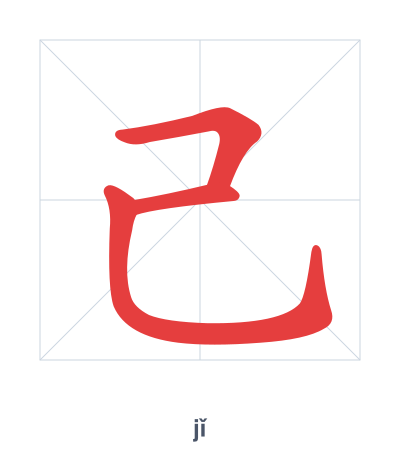
Open Hanzi Writer to see the animated stroke order and practice writing 己 with real-time feedback.
The character 己 (jǐ) is written with 3 strokes. Follow the standard Chinese stroke order: top to bottom, left to right, outside before inside. The radical 己 is one of its key components.
Practice the correct stroke order with the Hanzi Writer app to see animated stroke-by-stroke guidance with real-time feedback.
己 means self; oneself.
As an HSK Level 2 character, 己 is among the first characters beginners learn.
己 originally depicted a curved thread or coiled cord, symbolizing the idea of binding or self-reference. In ancient scripts, its winding shape suggested a connection back to oneself, which evolved into the meaning of 'self' or 'oneself'.
💡 Memory Tip: Picture a person curling their arm inward to point at their own chest, tracing the shape of 己 with their finger to say 'this is me'.
我自己去学校。
wǒ zì jǐ qù xué xiào
I go to school by myself.
他是我的知己。
tā shì wǒ de zhī jǐ
He is my confidant.
请发表个人己见。
qǐng fā biǎo gè rén jǐ jiàn
Please express your personal opinion.
Open Hanzi Writer to see the animated stroke order and practice writing 己 with real-time feedback.
✨ Animated stroke order · Handwriting recognition · HSK-graded practice · Free to use
己 is a simple character with 3 strokes and serves as its own radical. Its shape is thought to represent a coiled thread or a person curling inward, symbolizing the concept of 'self' or 'oneself'. There are no smaller components to break down—the whole character directly conveys the idea of self.