辎 (zī) means "Supply wagon; covered wagon" in Chinese. It has 12 strokes with the radical 车.
Rated 4.2/5 in difficulty (advanced).
Appears in 3+ common words including 辎重 (zī zhòng), 辎车 (zī chē), 辎骑 (zī qí).
Due to its 12 strokes, Hanzi Writer's error detection shows 辎 requires focused practice — most learners need 10+ attempts for consistent accuracy.
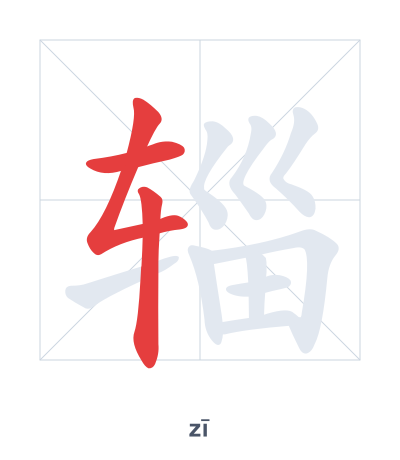
Open Hanzi Writer to see the animated stroke order and practice writing 辎 with real-time feedback.
The character 辎 (zī) is written with 12 strokes. Follow the standard Chinese stroke order: top to bottom, left to right, outside before inside. The radical 车 is one of its key components.
Practice the correct stroke order with the Hanzi Writer app to see animated stroke-by-stroke guidance with real-time feedback.
辎 means Supply wagon; covered wagon.
辎 is a phono-semantic compound: the radical 车 (cart) indicates a vehicle, and 甾 (zī, a type of earthenware container) provides the sound and suggests a covered compartment. Together, they depict a covered wagon used for transporting supplies, like a mobile storage box on wheels.
💡 Memory Tip: Picture a sturdy cart (车) with a big woven basket (甾) on top, filled to the brim with army supplies and covered with a tarp.
辎重车在后面。
zī zhòng chē zài hòu miàn
The supply wagons are at the back.
辎车装满了粮食。
zī chē zhuāng mǎn le liáng shí
The supply wagon is full of grain.
辎骑兵出发了。
zī qí bīng chū fā le
The supply cavalry has set out.
Open Hanzi Writer to see the animated stroke order and practice writing 辎 with real-time feedback.
✨ Animated stroke order · Handwriting recognition · HSK-graded practice · Free to use
辎 is composed of the radical 车 (vehicle) on the left, indicating it is related to transportation. The right side is 甾, which originally meant a basket or container and hints at storage. Together, they form the idea of a covered wagon used for carrying supplies.