肫 (zhūn) means "gizzard" in Chinese. It has 8 strokes with the radical 月.
Rated 3.7/5 in difficulty (challenging).
Appears in 3+ common words including 鸭肫 (yā zhūn), 鸡肫 (jī zhūn), 肫肝 (zhūn gān).
Due to its 8 strokes, Hanzi Writer's error detection shows 肫 requires focused practice — most learners need 10+ attempts for consistent accuracy.
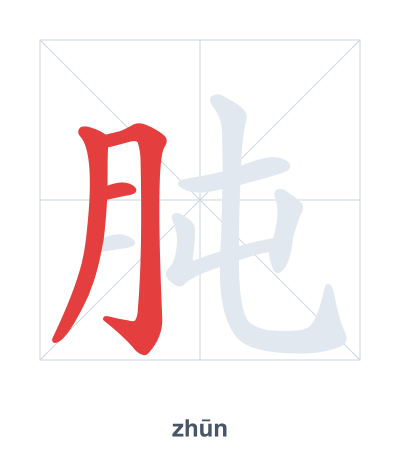
Open Hanzi Writer to see the animated stroke order and practice writing 肫 with real-time feedback.
The character 肫 (zhūn) is written with 8 strokes. Follow the standard Chinese stroke order: top to bottom, left to right, outside before inside. The radical 月 is one of its key components.
Practice the correct stroke order with the Hanzi Writer app to see animated stroke-by-stroke guidance with real-time feedback.
肫 means gizzard.
The left radical 月 (flesh/meat) indicates this character relates to an animal body part. The right component 屯 (tún, meaning 'to gather' or 'store') hints at the gizzard's function of storing and grinding food. Together, 肫 visually depicts a fleshy storage organ—the gizzard.
💡 Memory Tip: Picture a fleshy sack (月) shaped like a village (屯) where seeds are stored and crushed—that's the gizzard.
我喜欢吃鸭肫。
wǒ xǐ huān chī yā zhūn
I like eating duck gizzards.
鸡肫很有嚼劲。
jī zhūn hěn yǒu jué jìn
Chicken gizzards are very chewy.
这是一个肫肝拼盘。
zhè shì yí gè zhūn gān pīn pán
This is a gizzard and liver platter.
Open Hanzi Writer to see the animated stroke order and practice writing 肫 with real-time feedback.
✨ Animated stroke order · Handwriting recognition · HSK-graded practice · Free to use
肫 is made of the radical 月 (meat/flesh) on the left and 屯 (tún) on the right. The 月 radical indicates the character is related to meat or body parts, while 屯 provides the pronunciation zhūn. Together, they form a word meaning "gizzard," which is a muscular part of a bird's digestive system.