柊 (zhōng) means "Holly (specifically Osmanthus heterophyllus)." in Chinese. It has 9 strokes with the radical 木.
Rated 4/5 in difficulty (challenging).
Appears in 3+ common words including 柊树 (zhōng shù), 柊叶 (zhōng yè), 柊木 (zhōng mù).
Due to its 9 strokes, Hanzi Writer's error detection shows 柊 requires focused practice — most learners need 10+ attempts for consistent accuracy.
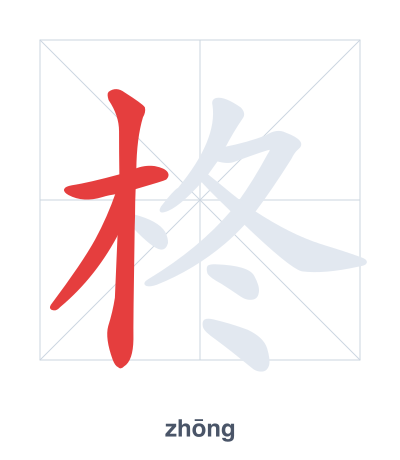
Open Hanzi Writer to see the animated stroke order and practice writing 柊 with real-time feedback.
The character 柊 (zhōng) is written with 9 strokes. Follow the standard Chinese stroke order: top to bottom, left to right, outside before inside. The radical 木 is one of its key components.
Practice the correct stroke order with the Hanzi Writer app to see animated stroke-by-stroke guidance with real-time feedback.
柊 means Holly (specifically Osmanthus heterophyllus)..
柊 combines the radical 木 'tree' with 冬 'winter', indicating a tree that is associated with or notable in winter. This refers to the holly (Osmanthus heterophyllus), an evergreen plant that remains green and often bears red berries during the cold season.
💡 Memory Tip: Picture a tree (木) standing strong in winter (冬), its spiky holly leaves poking through the snow.
这种植物叫柊树。
zhè zhòng zhí wù jiào zhōng shù
This plant is called Holly Osmanthus.
柊叶可以用来包粽子。
zhōng yè kě yǐ yòng lái bāo zòng zi
Phrynium leaves can be used to wrap zongzi (sticky rice dumplings).
这件家具是用柊木做的。
zhè jiàn jiā jù shì yòng zhōng mù zuò de
This piece of furniture is made of holly wood.
Open Hanzi Writer to see the animated stroke order and practice writing 柊 with real-time feedback.
✨ Animated stroke order · Handwriting recognition · HSK-graded practice · Free to use
柊 is composed of the radical 木 (tree/wood) on the left and 冬 (winter) on the right. The radical indicates it is a type of tree, and 冬 gives a hint to its meaning because holly trees stay green even in winter. Together, 柊 can be thought of as a 'winter tree,' which is the holly tree.