徴 (zhēng) means "to collect; to solicit" in Chinese. It has 14 strokes with the radical 彳.
Rated 4.2/5 in difficulty (advanced).
Appears in 3+ common words including 特徴 (tè zhēng), 徴收 (zhēng shōu), 徴求 (zhēng qiú).
Due to its 14 strokes, Hanzi Writer's error detection shows 徴 requires focused practice — most learners need 10+ attempts for consistent accuracy.
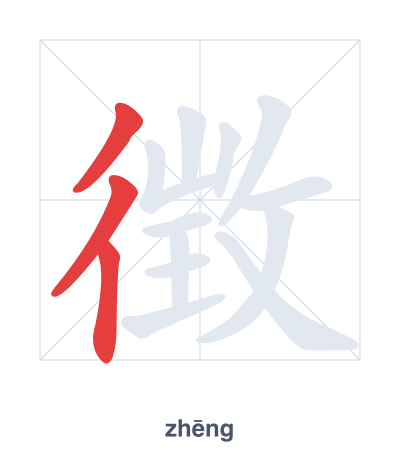
Open Hanzi Writer to see the animated stroke order and practice writing 徴 with real-time feedback.
The character 徴 (zhēng) is written with 14 strokes. Follow the standard Chinese stroke order: top to bottom, left to right, outside before inside. The radical 彳 is one of its key components.
Practice the correct stroke order with the Hanzi Writer app to see animated stroke-by-stroke guidance with real-time feedback.
徴 means to collect; to solicit.
The character 徴 combines the radical 彳 (to step, indicating action) with a right component that originally depicted a hand striking a drum or bell to summon people, thus conveying the meaning 'to collect' or 'to solicit'.
💡 Memory Tip: Imagine a collector (彳) walking up a mountain (山) to meet the king (王) and using a hand (攵) to collect taxes from him.
他的特征很明显。
tā de tè zhēng hěn míng xiǎn
His characteristics are very obvious.
政府在徴收税款。
zhèng fǔ zài zhēng shōu shuì kuǎn
The government is collecting taxes.
我在徴求你的意见。
wǒ zài zhēng qiú nǐ de yì jiàn
I am seeking your opinion.
Open Hanzi Writer to see the animated stroke order and practice writing 徴 with real-time feedback.
✨ Animated stroke order · Handwriting recognition · HSK-graded practice · Free to use
The left radical 彳 means 'step' or 'movement', suggesting an action. The right part combines 山 (mountain), 王 (king), and 攵 (to tap), which together create the idea of a king summoning people from a mountain to collect taxes or opinions.