蓁 (zhēn) means "Lush growth" in Chinese. It has 13 strokes with the radical 艹.
Rated 4.2/5 in difficulty (advanced).
Appears in 3+ common words including 蓁蓁 (zhēn zhēn), 桃之蓁蓁 (táo zhī zhēn zhēn), 蓁莽 (zhēn mǎng).
Due to its 13 strokes, Hanzi Writer's error detection shows 蓁 requires focused practice — most learners need 10+ attempts for consistent accuracy.
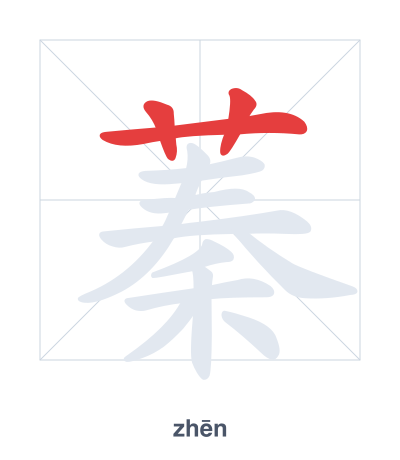
Open Hanzi Writer to see the animated stroke order and practice writing 蓁 with real-time feedback.
The character 蓁 (zhēn) is written with 13 strokes. Follow the standard Chinese stroke order: top to bottom, left to right, outside before inside. The radical 艹 is one of its key components.
Practice the correct stroke order with the Hanzi Writer app to see animated stroke-by-stroke guidance with real-time feedback.
蓁 means Lush growth.
The character 蓁 is a phono-semantic compound: the radical 艹 (grass) signifies its connection to vegetation, while 秦 (Qín) provides the pronunciation and also evokes the idea of abundance, as the Qin state was known for its fertile lands. Together, they depict grass growing in dense, lush thickets.
💡 Memory Tip: Picture grass (艹) spreading so thickly over the ancient Qin territory (秦) that it becomes an impenetrable, lush jungle.
草木蓁蓁。
cǎo mù zhēn zhēn
The vegetation is dense and thriving.
桃之蓁蓁很美。
táo zhī zhēn zhēn hěn měi
The lush peach tree is very beautiful.
这里是一片蓁莽。
zhè lǐ shì yī piàn zhēn mǎng
This is a place of overgrown weeds.
Open Hanzi Writer to see the animated stroke order and practice writing 蓁 with real-time feedback.
✨ Animated stroke order · Handwriting recognition · HSK-graded practice · Free to use
The top part is the radical 艹, which means grass or plants. The bottom part is 秦 (qín), which gives the sound but also hints at a large area. Together, 蓁 means plants growing thickly and lushly, like a dense field.