蚤 (zǎo) means "flea" in Chinese. It has 9 strokes with the radical 虫.
Rated 4/5 in difficulty (challenging).
Appears in 3+ common words including 跳蚤 (tiào zǎo), 蚤子 (zǎo zi), 杀跳蚤 (shā tiào zǎo).
Due to its 9 strokes, Hanzi Writer's error detection shows 蚤 requires focused practice — most learners need 10+ attempts for consistent accuracy.
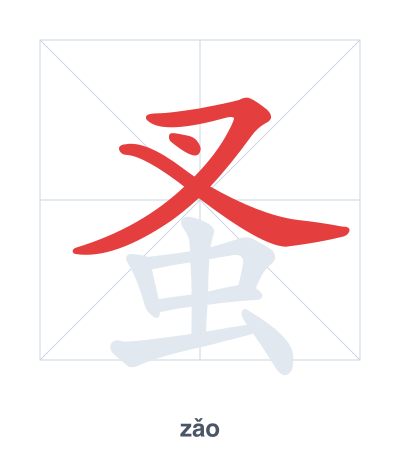
Open Hanzi Writer to see the animated stroke order and practice writing 蚤 with real-time feedback.
The character 蚤 (zǎo) is written with 9 strokes. Follow the standard Chinese stroke order: top to bottom, left to right, outside before inside. The radical 虫 is one of its key components.
Practice the correct stroke order with the Hanzi Writer app to see animated stroke-by-stroke guidance with real-time feedback.
蚤 means flea.
蚤 combines the insect radical 虫 with 㕚, an ancient pictograph of a hand with claws. The claw-like shape represents how a flea clings or bites, as fleas are insects with strong legs for jumping and piercing mouthparts. Originally the character also meant 'to scratch,' referring to the flea's irritating bite.
💡 Memory Tip: Imagine a flea (虫) with huge claws (㕚) scratching your skin—that's the annoying 蚤!
小狗身上有跳蚤。
xiǎo gǒu shēn shàng yǒu tiào zǎo
The puppy has fleas.
这种蚤子很小。
zhè zhǒng zǎo zi hěn xiǎo
This flea is very small.
医生在杀跳蚤。
yī shēng zài shā tiào zǎo
The doctor is killing fleas.
Open Hanzi Writer to see the animated stroke order and practice writing 蚤 with real-time feedback.
✨ Animated stroke order · Handwriting recognition · HSK-graded practice · Free to use
The character 蚤 combines the radical 虫 (insect) on top with the phonetic component 㕚 (ancient form of 爪, claw) below. The 虫 radical indicates it is a type of insect, while 㕚 suggests the flea's ability to jump or cling with its claws.