萸 (yú) means "cornel; dogwood" in Chinese. It has 11 strokes with the radical 艹.
Rated 4.2/5 in difficulty (advanced).
Appears in 3+ common words including 茱萸 (zhū yú), 茱萸肉 (zhū yú ròu), 茱萸酒 (zhū yú jiǔ).
Due to its 11 strokes, Hanzi Writer's error detection shows 萸 requires focused practice — most learners need 10+ attempts for consistent accuracy.
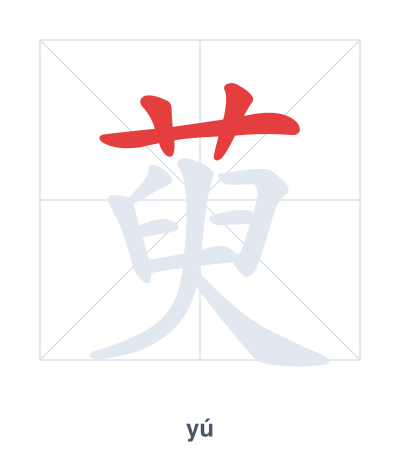
Open Hanzi Writer to see the animated stroke order and practice writing 萸 with real-time feedback.
The character 萸 (yú) is written with 11 strokes. Follow the standard Chinese stroke order: top to bottom, left to right, outside before inside. The radical 艹 is one of its key components.
Practice the correct stroke order with the Hanzi Writer app to see animated stroke-by-stroke guidance with real-time feedback.
萸 means cornel; dogwood.
萸 is a phono-semantic compound: the top radical 艹 (grass) indicates the character refers to a plant, while the bottom part 臾 (yú) provides phonetic cues for pronunciation. The character specifically names the cornel or dogwood plant, a shrub with red berries, common in traditional Chinese medicine and culture.
💡 Memory Tip: Picture a dogwood tree (艹) where each branch ends in a tiny red berry (imagining the 臾 part as small clustered fruits hanging down).
重阳节要插茱萸。
chóng yáng jié yào chā zhū yú
Cornel twigs are worn on the Double Ninth Festival.
茱萸肉可以入药。
zhū yú ròu kě yǐ rù yào
Cornelian cherry pulp can be used as medicine.
他喝了一杯茱萸酒。
tā hē le yī bēi zhū yú jiǔ
He drank a cup of dogwood wine.
Open Hanzi Writer to see the animated stroke order and practice writing 萸 with real-time feedback.
✨ Animated stroke order · Handwriting recognition · HSK-graded practice · Free to use
萸 is composed of the radical 艹 (grass) on top, indicating a plant, and the phonetic component 臾 (yú) below, which hints at the pronunciation. Together, they show a plant called cornel or dogwood, which is a type of shrub.