蚴 (yòu) means "Larva (character component)" in Chinese. It has 11 strokes with the radical 虫.
Rated 4.2/5 in difficulty (advanced).
Appears in 3+ common words including 尾蚴 (wěi yòu), 胞蚴 (bāo yòu), 蚴虫 (yòu chóng).
Due to its 11 strokes, Hanzi Writer's error detection shows 蚴 requires focused practice — most learners need 10+ attempts for consistent accuracy.
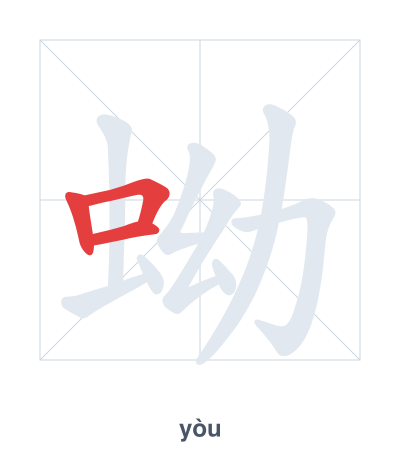
Open Hanzi Writer to see the animated stroke order and practice writing 蚴 with real-time feedback.
The character 蚴 (yòu) is written with 11 strokes. Follow the standard Chinese stroke order: top to bottom, left to right, outside before inside. The radical 虫 is one of its key components.
Practice the correct stroke order with the Hanzi Writer app to see animated stroke-by-stroke guidance with real-time feedback.
蚴 means Larva (character component).
蚴 is a compound character formed from the radical 虫 (insect) and the phonetic component 幼 (young), meaning a young insect or larva. The left side 虫 indicates the creature type, while 幼 conveys the idea of immaturity or early stage of development.
💡 Memory Tip: Picture a tiny wriggling bug (虫) that is so young (幼) it hasn't grown its wings yet – that's the larva.
这种水里有尾蚴。
zhè zhǒng shuǐ lǐ yǒu wěi yòu
There are cercariae in this water.
医生在观察胞蚴。
yī shēng zài guān chá bāo yòu
The doctor is observing the sporocyst.
蚴虫是幼小的虫子。
yòu chóng shì yòu xiǎo de chóng zi
Larvae are young insects.
Open Hanzi Writer to see the animated stroke order and practice writing 蚴 with real-time feedback.
✨ Animated stroke order · Handwriting recognition · HSK-graded practice · Free to use
蚴 is composed of the radical 虫 (insect/worm) on the left and the phonetic component 幼 (yòu, meaning young) on the right. The 虫 radical indicates that the character is related to worms or insects, while 幼 suggests a young or larval stage. Together they form the meaning of "larva" — a young, immature insect or worm.