蓥 (yíng) means "to polish; bright" in Chinese. It has 13 strokes with the radical 艹.
Rated 4.2/5 in difficulty (advanced).
Appears in 3+ common words including 华蓥山 (huá yíng shān), 蓥华 (yíng huá), 蓥石 (yíng shí).
Due to its 13 strokes, Hanzi Writer's error detection shows 蓥 requires focused practice — most learners need 10+ attempts for consistent accuracy.
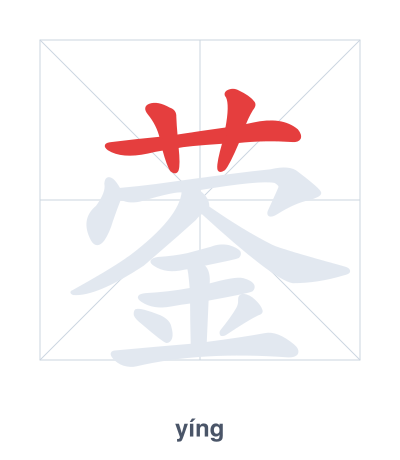
Open Hanzi Writer to see the animated stroke order and practice writing 蓥 with real-time feedback.
The character 蓥 (yíng) is written with 13 strokes. Follow the standard Chinese stroke order: top to bottom, left to right, outside before inside. The radical 艹 is one of its key components.
Practice the correct stroke order with the Hanzi Writer app to see animated stroke-by-stroke guidance with real-time feedback.
蓥 means to polish; bright.
蓥 is a compound of the grass radical 艹 and 荧, which itself combines a roof (冖) and fire (火) to mean 'shine, glimmer.' The original sense may have been a glossy plant, but the character extended to mean 'bright' and 'to polish' through the shining imagery of the phonetic component.
💡 Memory Tip: Picture a patch of grass (艹) being polished until it glows like a hidden fire (火) under a roof (冖) – that's 蓥, to polish to brightness.
华蓥山在四川省。
huá yíng shān zài sì chuān shěng
Huaying Mountain is in Sichuan Province.
这里是蓥华镇。
zhè lǐ shì yíng huá zhèn
This is Yinghua Town.
这块蓥石很亮。
zhè kuài yíng shí hěn liàng
This polished stone is very bright.
Open Hanzi Writer to see the animated stroke order and practice writing 蓥 with real-time feedback.
✨ Animated stroke order · Handwriting recognition · HSK-graded practice · Free to use
蓥 is composed of the grass radical 艹 on top and the phonetic component 荧 (yíng) below. The grass radical hints at a plant-related origin, while the phonetic part suggests the pronunciation and the idea of brightness, giving the combined meaning 'to polish' or 'bright'.