璎 (yīng) means "Jade-like stone" in Chinese. It has 15 strokes with the radical 王.
Rated 4.2/5 in difficulty (advanced).
Appears in 3+ common words including 璎珞 (yīng luò), 璎璎 (yīng yīng), 金璎 (jīn yīng).
Due to its 15 strokes, Hanzi Writer's error detection shows 璎 requires focused practice — most learners need 10+ attempts for consistent accuracy.
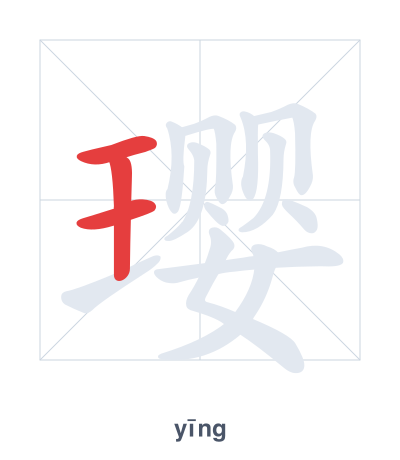
Open Hanzi Writer to see the animated stroke order and practice writing 璎 with real-time feedback.
The character 璎 (yīng) is written with 15 strokes. Follow the standard Chinese stroke order: top to bottom, left to right, outside before inside. The radical 王 is one of its key components.
Practice the correct stroke order with the Hanzi Writer app to see animated stroke-by-stroke guidance with real-time feedback.
璎 means Jade-like stone.
璎 is a phono-semantic compound. The left radical 王 (jade) indicates it relates to precious stones, while the right component 婴 (yīng, meaning 'baby') provides the sound and also suggests something small and precious, like a baby or tiny jade ornament. It originally referred to jade-like stones used in necklaces or adornments.
💡 Memory Tip: Imagine a baby (婴) wearing a sparkling jade (王) necklace made of beautiful jade-like stones (璎).
她戴着一串璎珞。
tā dài zhe yī chuàn yīng luò
She is wearing an ornamental necklace.
璎璎是我的好朋友。
yīng yīng shì wǒ de hǎo péng yǒu
Yingying is my good friend.
这个金璎非常漂亮。
zhè ge jīn yīng fēi cháng piào liàng
This golden necklet is very beautiful.
Open Hanzi Writer to see the animated stroke order and practice writing 璎 with real-time feedback.
✨ Animated stroke order · Handwriting recognition · HSK-graded practice · Free to use
The character 璎 is composed of the radical 王 (jade) on the left and 婴 (yīng, baby) on the right. The radical shows it relates to jade or stone, while 婴 originally meant "to wear around the neck," so together they suggest a jade-like stone used as a necklace ornament.