Hanzi Writer

How to Write 瑁 (mào) — Meaning “Mao (ornamental jade; part of 'tortoiseshell').”

mào 13 strokes Radical: 王

瑁 (mào) means "Mao (ornamental jade; part of 'tortoiseshell')." in Chinese. It has 13 strokes with the radical 王.

Rated 4.2/5 in difficulty (advanced).

Appears in 3+ common words including 玳瑁 (dài mào), 玳瑁猫 (dài mào māo), 玳瑁壳 (dài mào ké).

Due to its 13 strokes, Hanzi Writer's error detection shows 瑁 requires focused practice — most learners need 10+ attempts for consistent accuracy.
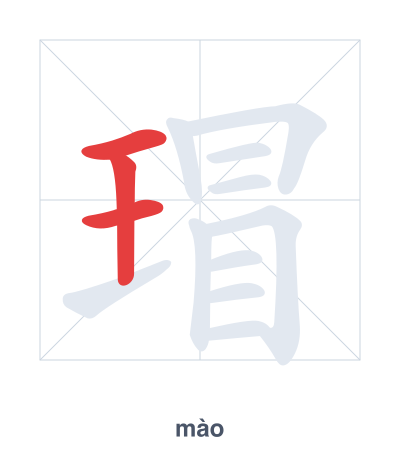
Stroke order practice for 瑁 - mào

Practice Writing 瑁 (mào)

Open Hanzi Writer to see the animated stroke order and practice writing 瑁 with real-time feedback.

The character (mào) is written with 13 strokes. Follow the standard Chinese stroke order: top to bottom, left to right, outside before inside. The radical is one of its key components.

Practice the correct stroke order with the Hanzi Writer app to see animated stroke-by-stroke guidance with real-time feedback.

means Mao (ornamental jade; part of 'tortoiseshell')..

Character
Pinyinmào (mao)
MeaningMao (ornamental jade; part of 'tortoiseshell').
Strokes13
Radical
Difficulty4.2/5

瑁 combines the jade radical 王 (jade) with 冒 (mào, meaning 'to cover' or 'to risk'), which itself shows a hat-like cover over an eye. Originally an ornamental jade piece, it came to denote tortoiseshell (as in 玳瑁), likely because the turtle's shell acts as a patterned covering.

💡 Memory Tip: Picture a jade-colored turtle (王) wearing a hat (冒) made of shiny tortoiseshell pattern.

dài mào
hawksbill turtle / tortoiseshell
dài mào māo
tortoiseshell cat
dài mào ké
tortoiseshell

玳瑁是海龟。

dài mào shì hǎi guī

The hawksbill is a sea turtle.

玳瑁猫很可爱。

dài mào māo hěn kě ài

Tortoiseshell cats are very cute.

玳瑁壳很硬。

dài mào ké hěn yìng

Tortoiseshell is very hard.

Character Pinyin Strokes Radical
(current) mào 13
qiú 11
láng 11
11
Stroke order practice for 瑁 - mào

Practice Writing 瑁 (mào)

Open Hanzi Writer to see the animated stroke order and practice writing 瑁 with real-time feedback.

✨ Animated stroke order · Handwriting recognition · HSK-graded practice · Free to use

Frequently Asked Questions about 瑁

瑁 is made of two parts: the radical 王 (jade) on the left, and the phonetic component 冒 (mào) on the right. The 王 radical shows that 瑁 is related to jade or precious stones, while 冒 provides the pronunciation mào. Together they form the character for ornamental jade, especially in the word 玳瑁 (tortoiseshell).

Characters with Radical 王

Other 13-Stroke Characters