轶 (yì) means "Extraordinary; to exceed; anecdote" in Chinese. It has 9 strokes with the radical 车.
Rated 4/5 in difficulty (challenging).
Appears in 3+ common words including 轶事 (yì shì), 轶闻 (yì wén), 散轶 (sàn yì).
Due to its 9 strokes, Hanzi Writer's error detection shows 轶 requires focused practice — most learners need 10+ attempts for consistent accuracy.
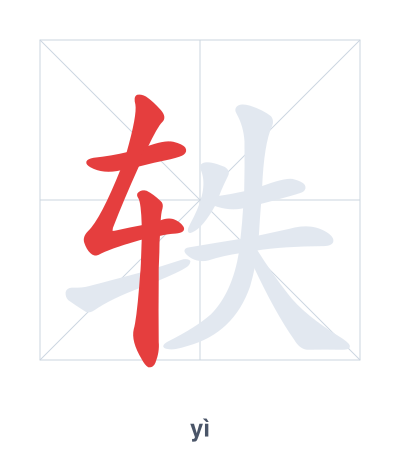
Open Hanzi Writer to see the animated stroke order and practice writing 轶 with real-time feedback.
The character 轶 (yì) is written with 9 strokes. Follow the standard Chinese stroke order: top to bottom, left to right, outside before inside. The radical 车 is one of its key components.
Practice the correct stroke order with the Hanzi Writer app to see animated stroke-by-stroke guidance with real-time feedback.
轶 means Extraordinary; to exceed; anecdote.
轶 is a compound character combining the radical 车 (vehicle/chariot) and the phonetic component 失 (lose/exceed). Originally it depicted a chariot racing past another, suggesting the idea of overtaking or exceeding limits, which later expanded to mean 'extraordinary' or 'anecdote' (something that exceeds the ordinary).
💡 Memory Tip: Picture a chariot (车) racing so fast it loses (失) control and zooms past everything—truly an extraordinary, exceeding spectacle!
这是一个名人轶事。
zhè shì yí gè míng rén yì shì
This is a celebrity anecdote.
我听过这个轶闻。
wǒ tīng guò zhè ge yì wén
I've heard this anecdote before.
很多古书已经散轶了。
hěn duō gǔ shū yǐ jīng sàn yì le
Many ancient books have been lost.
Open Hanzi Writer to see the animated stroke order and practice writing 轶 with real-time feedback.
✨ Animated stroke order · Handwriting recognition · HSK-graded practice · Free to use
The character 轶 is composed of the radical 车 (vehicle) on the left and 失 (to lose) on the right. The combination suggests something that has "lost" its normal track, giving meanings like "to exceed" or "extraordinary." It also relates to "lost" events, hence "anecdote" (轶事).