悒 (yì) means "depressed" in Chinese. It has 10 strokes with the radical 忄.
Rated 4.2/5 in difficulty (advanced).
Appears in 3+ common words including 悒悒 (yì yì), 忧悒 (yōu yì), 悒闷 (yì mèn).
Due to its 10 strokes, Hanzi Writer's error detection shows 悒 requires focused practice — most learners need 10+ attempts for consistent accuracy.
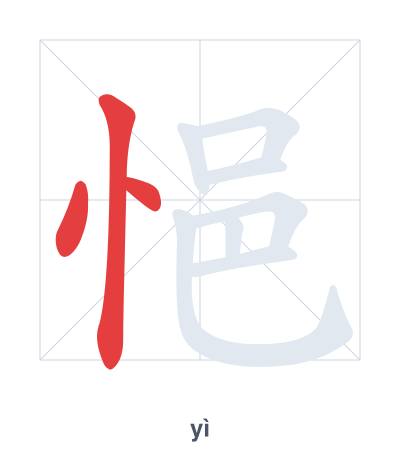
Open Hanzi Writer to see the animated stroke order and practice writing 悒 with real-time feedback.
The character 悒 (yì) is written with 10 strokes. Follow the standard Chinese stroke order: top to bottom, left to right, outside before inside. The radical 忄 is one of its key components.
Practice the correct stroke order with the Hanzi Writer app to see animated stroke-by-stroke guidance with real-time feedback.
悒 means depressed.
悒 is a phono-semantic compound: the radical 忄 (heart) indicates it relates to emotions, while the component 邑 (yì, meaning 'city' or 'state') provides the pronunciation. The idea of a heavy heart or feeling trapped in a confined urban space contributes to the meaning of being depressed or anxious.
💡 Memory Tip: Picture your heart (忄) stuck inside a gloomy city (邑)—no wonder you feel depressed.
他整天悒悒不乐。
tā zhěng tiān yì yì bù lè
He is depressed and gloomy all day long.
他的眼神很忧悒。
tā de yǎn shén hěn yōu yì
His gaze is very melancholy.
心中感到有些悒闷。
xīn zhōng gǎn dào yǒu xiē yì mèn
Feeling somewhat depressed and gloomy.
Open Hanzi Writer to see the animated stroke order and practice writing 悒 with real-time feedback.
✨ Animated stroke order · Handwriting recognition · HSK-graded practice · Free to use
悒 is made of the radical 忄 (heart) on the left, and the component 邑 (yì, city/state) on the right. The heart radical connects to emotions, so together it suggests a heavy or troubled feeling in the heart, like being depressed.