埶 (yì) means "skill / art / to plant" in Chinese. It has 11 strokes with the radical 土.
Rated 3.9/5 in difficulty (challenging).
Appears in 3+ common words including 埶艺 (yì yì), 埶能 (yì néng), 埶位 (yì wèi).
Due to its 11 strokes, Hanzi Writer's error detection shows 埶 requires focused practice — most learners need 10+ attempts for consistent accuracy.
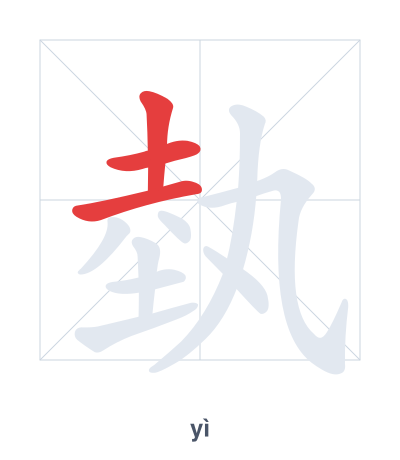
Open Hanzi Writer to see the animated stroke order and practice writing 埶 with real-time feedback.
The character 埶 (yì) is written with 11 strokes. Follow the standard Chinese stroke order: top to bottom, left to right, outside before inside. The radical 土 is one of its key components.
Practice the correct stroke order with the Hanzi Writer app to see animated stroke-by-stroke guidance with real-time feedback.
埶 means skill / art / to plant.
埶 originally depicted a person (大) kneeling and planting a tree or seedling into the earth (土) with both hands (丸 as a stylized representation of hands). This image of planting gave rise to the meanings 'to plant' and, by extension, 'skill' or 'art'—the expertise required for cultivation.
💡 Memory Tip: Picture a skilled gardener (the top as a person) using both hands (丸) to place a round seed into the ground (土), mastering the art of planting.
他的埶艺很精湛。
tā de yì yì hěn jīng zhàn
His skills are superb.
此人很有埶能。
cǐ rén hěn yǒu yì néng
This person is very capable.
他的埶位很高。
tā de yì wèi hěn gāo
His social status is very high.
Open Hanzi Writer to see the animated stroke order and practice writing 埶 with real-time feedback.
✨ Animated stroke order · Handwriting recognition · HSK-graded practice · Free to use
The character 埶 is composed of the radical 土 (earth) at the bottom and the component 坴 (lù) on top. 坴 is related to planting or standing on earth, so together they suggest "planting" and by extension "skill" or "art" — a skill rooted in working with the earth.