诒 (yí) means "To mislead; to leave behind" in Chinese. It has 7 strokes with the radical 讠.
Rated 3.2/5 in difficulty (challenging).
Appears in 3+ common words including 诒误 (yí wù), 诒笑 (yí xiào), 诒害 (yí hài).
Due to its 7 strokes, Hanzi Writer's error detection shows 诒 requires focused practice — most learners need 10+ attempts for consistent accuracy.
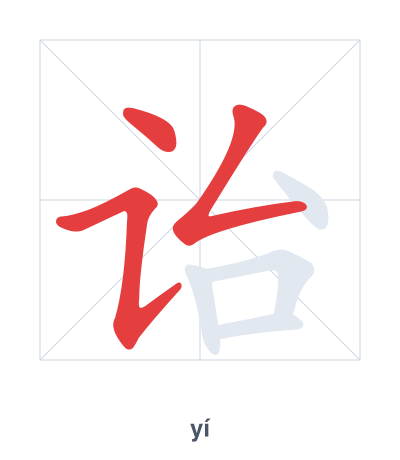
Open Hanzi Writer to see the animated stroke order and practice writing 诒 with real-time feedback.
The character 诒 (yí) is written with 7 strokes. Follow the standard Chinese stroke order: top to bottom, left to right, outside before inside. The radical 讠 is one of its key components.
Practice the correct stroke order with the Hanzi Writer app to see animated stroke-by-stroke guidance with real-time feedback.
诒 means To mislead; to leave behind.
诒 combines the radical 讠 (speech) with 台 (a phonetic component), suggesting words that deceive (mislead) or pass on something (leave behind).
💡 Memory Tip: Imagine someone on a stage (台) using speech (讠) to mislead the crowd, then leaving behind a false legacy.
别诒误了工作大事。
bié yí wù le gōng zuò dà shì
Don't delay important work matters.
这样做会诒笑大方。
zhè yàng zuò huì yí xiào dà fāng
Doing this will make you a laughing stock among experts.
这种行为会诒害子孙。
zhè zhǒng xíng wéi huì yí hài zǐ sūn
This behavior will bring harm to future generations.
Open Hanzi Writer to see the animated stroke order and practice writing 诒 with real-time feedback.
✨ Animated stroke order · Handwriting recognition · HSK-graded practice · Free to use
诒 is formed by the radical 讠 (speech) on the left and 台 on the right. The radical suggests that the character relates to words or speaking, while 台 can mean 'to give' or 'platform', together implying something harmful that is given through speech – you mislead someone with words or leave behind trouble.