蛘 (yáng) means "weevil" in Chinese. It has 12 strokes with the radical 虫.
Rated 4.2/5 in difficulty (advanced).
Appears in 3+ common words including 蛘子 (yáng zi), 抓蛘子 (zhuā yáng zi), 蛘虫 (yáng chóng).
Due to its 12 strokes, Hanzi Writer's error detection shows 蛘 requires focused practice — most learners need 10+ attempts for consistent accuracy.
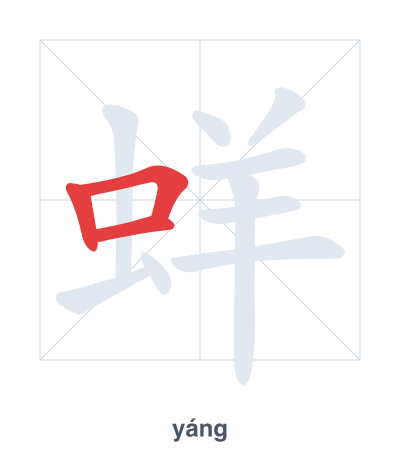
Open Hanzi Writer to see the animated stroke order and practice writing 蛘 with real-time feedback.
The character 蛘 (yáng) is written with 12 strokes. Follow the standard Chinese stroke order: top to bottom, left to right, outside before inside. The radical 虫 is one of its key components.
Practice the correct stroke order with the Hanzi Writer app to see animated stroke-by-stroke guidance with real-time feedback.
蛘 means weevil.
蛘 is a semantic-phonetic compound. The radical 虫 (insect) indicates it belongs to the insect category, while 羊 (yáng) serves as the phonetic component hinting at the pronunciation. The character specifically denotes a weevil, a type of beetle that often infests stored grain.
💡 Memory Tip: Imagine a huge weevil with a sheep's (羊) fluffy body crawling on a grain sack, its tiny insect (虫) legs gripping the surface.
米里长了很多蛘子。
mǐ lǐ zhǎng le hěn duō yáng zi
Many weevils have grown in the rice.
妈妈在米里抓蛘子。
mā mā zài mǐ lǐ zhuā yáng zi
Mom is picking weevils out of the rice.
这种蛘虫很小。
zhè zhǒng yáng chóng hěn xiǎo
This grain beetle is very small.
Open Hanzi Writer to see the animated stroke order and practice writing 蛘 with real-time feedback.
✨ Animated stroke order · Handwriting recognition · HSK-graded practice · Free to use
蛘 is made of the radical 虫 (insect) on the left, indicating it is a type of insect, and 羊 (sheep) on the right, which suggests the pronunciation 'yáng'. The radical directly connects to the meaning 'weevil', an insect that damages stored grains.