晏 (yàn) means "late; peaceful" in Chinese. It has 10 strokes with the radical 日.
Rated 4.2/5 in difficulty (advanced).
Appears in 3+ common words including 晏起 (yàn qǐ), 晏安 (yàn ān), 岁晏 (suì yàn).
Due to its 10 strokes, Hanzi Writer's error detection shows 晏 requires focused practice — most learners need 10+ attempts for consistent accuracy.
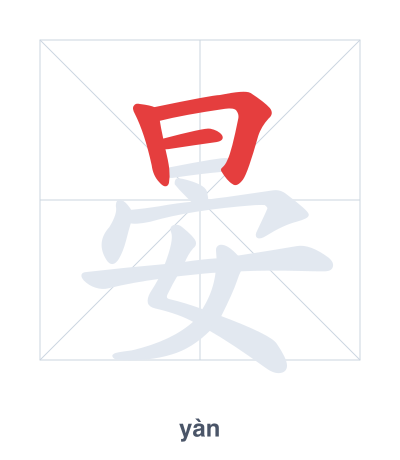
Open Hanzi Writer to see the animated stroke order and practice writing 晏 with real-time feedback.
The character 晏 (yàn) is written with 10 strokes. Follow the standard Chinese stroke order: top to bottom, left to right, outside before inside. The radical 日 is one of its key components.
Practice the correct stroke order with the Hanzi Writer app to see animated stroke-by-stroke guidance with real-time feedback.
晏 means late; peaceful.
晏 combines the sun (日) with 安 (peaceful), originally meaning a clear sky or calm weather. Over time, it extended to mean 'late' (as in late afternoon when the sky is clear) and 'peaceful', reflecting a serene time of day.
💡 Memory Tip: Picture the sun (日) resting under a peaceful roof (安) to remember that 晏 means a calm, late afternoon.
他每天晏起。
tā měi tiān yàn qǐ
He gets up late every day.
生活很晏安。
shēng huó hěn yàn ān
Life is very peaceful.
岁晏天气冷。
suì yàn tiān qì lěng
The weather is cold at the end of the year.
Open Hanzi Writer to see the animated stroke order and practice writing 晏 with real-time feedback.
✨ Animated stroke order · Handwriting recognition · HSK-graded practice · Free to use
晏 is composed of 日 (sun/day) on top and 安 (peaceful) on the bottom. The sun suggests brightness or time, while 安 brings the meaning of peace, together forming ideas like peaceful days or late times.