蚜 (yá) means "aphid" in Chinese. It has 10 strokes with the radical 虫.
Rated 4.2/5 in difficulty (advanced).
Appears in 3+ common words including 蚜虫 (yá chóng), 杀蚜虫 (shā yá chóng), 绿蚜 (lǜ yá).
Due to its 10 strokes, Hanzi Writer's error detection shows 蚜 requires focused practice — most learners need 10+ attempts for consistent accuracy.
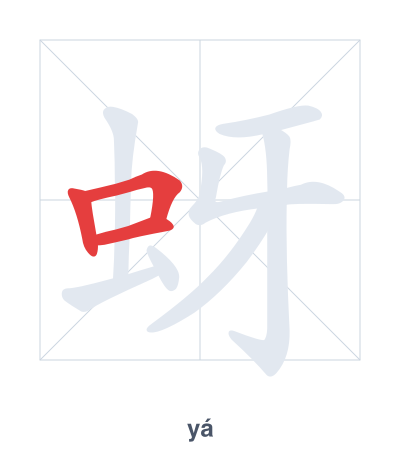
Open Hanzi Writer to see the animated stroke order and practice writing 蚜 with real-time feedback.
The character 蚜 (yá) is written with 10 strokes. Follow the standard Chinese stroke order: top to bottom, left to right, outside before inside. The radical 虫 is one of its key components.
Practice the correct stroke order with the Hanzi Writer app to see animated stroke-by-stroke guidance with real-time feedback.
蚜 means aphid.
蚜 is a compound character: the radical 虫 (insect) indicates it's a type of insect, while 牙 (yá, tooth) provides the pronunciation. The tooth component may also subtly reference the aphid's piercing mouthparts used to suck plant sap.
💡 Memory Tip: Picture an aphid with two sharp fangs (牙) on its insect body (虫) chomping on a leaf.
植物上有许多蚜虫。
zhí wù shàng yǒu xǔ duō yá chóng
There are many aphids on the plant.
我们要杀蚜虫。
wǒ men yào shā yá chóng
We need to kill the aphids.
绿蚜会伤害叶子。
lǜ yá huì shāng hài yè zi
Green aphids can damage leaves.
Open Hanzi Writer to see the animated stroke order and practice writing 蚜 with real-time feedback.
✨ Animated stroke order · Handwriting recognition · HSK-graded practice · Free to use
蚜 is made of two parts: the radical 虫 (insect) on the left, and the phonetic component 牙 (yá, meaning tooth) on the right. The 虫 radical tells you it is a type of insect, while 牙 gives the sound "yá" and hints at the tiny, tooth-like mouthparts of an aphid.