栩 (xǔ) means "Vivid; Oak tree" in Chinese. It has 10 strokes with the radical 木.
Rated 4.2/5 in difficulty (advanced).
Appears in 3+ common words including 栩栩如生 (xǔ xǔ rú shēng), 栩栩 (xǔ xǔ), 栩然 (xǔ rán).
Due to its 10 strokes, Hanzi Writer's error detection shows 栩 requires focused practice — most learners need 10+ attempts for consistent accuracy.
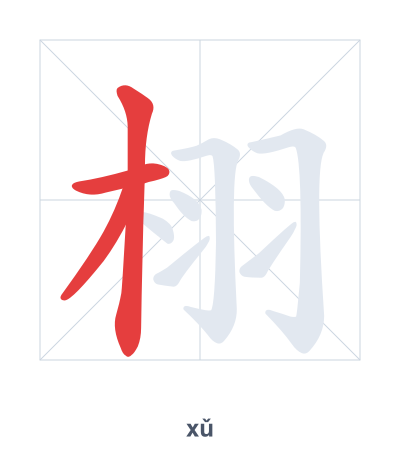
Open Hanzi Writer to see the animated stroke order and practice writing 栩 with real-time feedback.
The character 栩 (xǔ) is written with 10 strokes. Follow the standard Chinese stroke order: top to bottom, left to right, outside before inside. The radical 木 is one of its key components.
Practice the correct stroke order with the Hanzi Writer app to see animated stroke-by-stroke guidance with real-time feedback.
栩 means Vivid; Oak tree.
The character 栩 combines the radical 木 (tree) and the component 羽 (feather). It originally referred to the oak tree, whose leaves are shaped like feathers, and later extended to mean 'vivid' through the reduplicated form 栩栩, which describes lively, lifelike movement akin to feathers fluttering.
💡 Memory Tip: Picture a tree (木) adorned with feathers (羽) that look so vivid and realistic you think the birds are alive.
这幅画画得栩栩如生。
zhè fú huà huà dé xǔ xǔ rú shēng
This painting is vividly lifelike.
蝴蝶在花间栩栩飞舞。
hú dié zài huā jiān xǔ xǔ fēi wǔ
The butterfly is flying lifelike among the flowers.
他栩然自得地笑着。
tā xǔ rán zì dé dì xiào zhe
He smiled with a look of self-satisfaction.
Open Hanzi Writer to see the animated stroke order and practice writing 栩 with real-time feedback.
✨ Animated stroke order · Handwriting recognition · HSK-graded practice · Free to use
The character 栩 is made of two parts: the left side is 木 (wood/tree), and the right side is 羽 (feather). The wood radical hints at the "oak tree" meaning, while the feather component suggests something light and delicate, connecting to the sense of "vivid" or "lifelike" as in a bird's feathers in motion.