藓 (xiǎn) means "moss" in Chinese. It has 17 strokes with the radical 艹.
Rated 4.2/5 in difficulty (advanced).
Appears in 3+ common words including 苔藓 (tái xiǎn), 藓类 (xiǎn lèi), 青藓 (qīng xiǎn).
Due to its 17 strokes, Hanzi Writer's error detection shows 藓 requires focused practice — most learners need 10+ attempts for consistent accuracy.
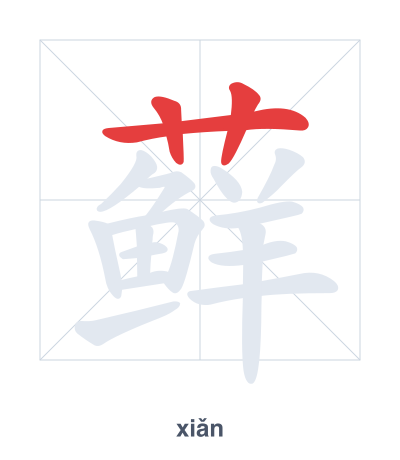
Open Hanzi Writer to see the animated stroke order and practice writing 藓 with real-time feedback.
The character 藓 (xiǎn) is written with 17 strokes. Follow the standard Chinese stroke order: top to bottom, left to right, outside before inside. The radical 艹 is one of its key components.
Practice the correct stroke order with the Hanzi Writer app to see animated stroke-by-stroke guidance with real-time feedback.
藓 means moss.
藓 is a phono-semantic compound: the radical 艹 (grass) indicates it is a plant, and 鲜 (xiǎn, meaning fresh or fish) provides the pronunciation. Moss often grows in cool, moist places, evoking a sense of freshness.
💡 Memory Tip: Picture fresh (鲜) green grass (艹) spreading over a damp rock like a soft carpet of moss.
石头上长了苔藓。
shí tou shàng zhǎng le tái xiǎn
Moss has grown on the stone.
藓类植物很矮小。
xiǎn lèi zhí wù hěn ǎi xiǎo
Mosses are very short.
这里的青藓很多。
zhè lǐ de qīng xiǎn hěn duō
There is a lot of green moss here.
Open Hanzi Writer to see the animated stroke order and practice writing 藓 with real-time feedback.
✨ Animated stroke order · Handwriting recognition · HSK-graded practice · Free to use
藓 is composed of two parts: the radical 艹 (grass radical) on top, which indicates the character relates to plants, and the phonetic component 鲜 (xiān, meaning fresh) underneath. Together, the grass radical signals that 藓 refers to a type of plant, specifically moss, which often grows in fresh, damp environments.