夋 (qūn) means "To move slowly / To dawdle (archaic)" in Chinese. It has 7 strokes with the radical 夂.
Rated 3.5/5 in difficulty (challenging).
Appears in 3+ common words including 夋夋 (qūn qūn), 夋兔 (qūn tù), 夋足 (qūn zú).
Due to its 7 strokes, Hanzi Writer's error detection shows 夋 requires focused practice — most learners need 10+ attempts for consistent accuracy.
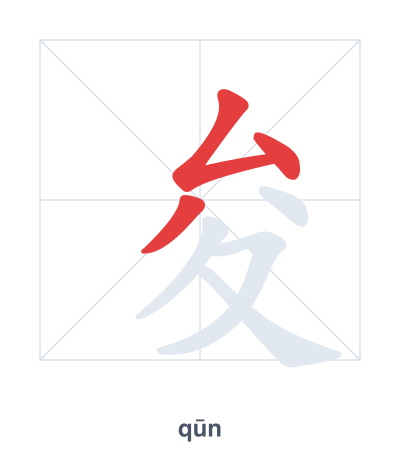
Open Hanzi Writer to see the animated stroke order and practice writing 夋 with real-time feedback.
The character 夋 (qūn) is written with 7 strokes. Follow the standard Chinese stroke order: top to bottom, left to right, outside before inside. The radical 夂 is one of its key components.
Practice the correct stroke order with the Hanzi Writer app to see animated stroke-by-stroke guidance with real-time feedback.
夋 means To move slowly / To dawdle (archaic).
| Character | 夋 |
| Pinyin | qūn (qun) |
| Meaning | To move slowly / To dawdle (archaic) |
| Strokes | 7 |
| Radical | 夂 |
| Difficulty | 3.5/5 |
夋 combines 夂 (a pictograph of a foot moving slowly) with 允 (a person with a drooping head), depicting someone stooping or hesitating, thus moving sluggishly. The top radical 夂 directly conveys the sense of delayed or trudging steps.
💡 Memory Tip: Picture a person (夂) making a slow, loopy 'Q' shape with their body (like 允) as they dawdle along the path.
他走起路来夋夋的。
tā zǒu qǐ lù lái qūn qūn de
He walks with a slow and dignified pace.
夋兔在林中跑。
qūn tù zài lín zhōng pǎo
The rabbit is running in the forest.
他的夋足很有力。
tā de qūn zú hěn yǒu lì
His stride is very powerful.
Open Hanzi Writer to see the animated stroke order and practice writing 夋 with real-time feedback.
✨ Animated stroke order · Handwriting recognition · HSK-graded practice · Free to use
夋 consists of the radical 夂 (meaning 'walk slowly' or 'go') at the top and 允 underneath. The combination suggests a sense of slow or hesitant movement, matching its archaic meaning of dawdling or moving slowly.