夆 (féng) means "To meet / To resist (archaic)" in Chinese. It has 7 strokes with the radical 夂.
Rated 3.5/5 in difficulty (challenging).
Appears in 3+ common words including 夆集 (féng jí), 夆起 (féng qǐ), 夆夆 (féng féng).
Due to its 7 strokes, Hanzi Writer's error detection shows 夆 requires focused practice — most learners need 10+ attempts for consistent accuracy.
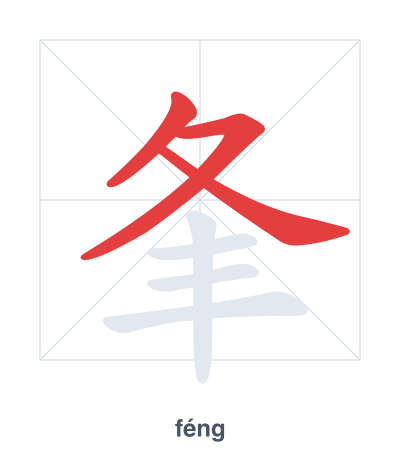
Open Hanzi Writer to see the animated stroke order and practice writing 夆 with real-time feedback.
The character 夆 (féng) is written with 7 strokes. Follow the standard Chinese stroke order: top to bottom, left to right, outside before inside. The radical 夂 is one of its key components.
Practice the correct stroke order with the Hanzi Writer app to see animated stroke-by-stroke guidance with real-time feedback.
夆 means To meet / To resist (archaic).
| Character | 夆 |
| Pinyin | féng (feng) |
| Meaning | To meet / To resist (archaic) |
| Strokes | 7 |
| Radical | 夂 |
| Difficulty | 3.5/5 |
夆 combines the radical 夂 (walking or moving slowly) with 丰 (abundant, also phonetic) to suggest the motion of encountering something—hence the original meanings 'to meet' or 'to resist' (as in standing in the way).
💡 Memory Tip: Picture a walking figure (夂) with two outstretched arms like a barrier (the three horizontal lines of 丰), either greeting someone or pushing them back—meeting or resisting.
许多人夆集在这里。
xǔ duō rén féng jí zài zhè lǐ
Many people gathered here.
各种问题夆起。
gè zhǒng wèn tí féng qǐ
Various problems are arising one after another.
山势夆夆。
shān shì féng féng
The mountain peaks are sharp and numerous.
Open Hanzi Writer to see the animated stroke order and practice writing 夆 with real-time feedback.
✨ Animated stroke order · Handwriting recognition · HSK-graded practice · Free to use
夆 is composed of the radical 夂 (meaning 'leg' or 'to go') on top and 丰 (meaning 'abundant' or 'lush') below. The top part suggests movement or action, while the bottom implies abundance, together conveying the idea of people or things coming together or meeting in great numbers. The archaic meaning 'to resist' may come from the image of opposing forces meeting each other.