犀 (xī) means "rhinoceros; sharp" in Chinese. It has 12 strokes with the radical 尸.
Rated 4.2/5 in difficulty (advanced).
Appears in 3+ common words including 犀牛 (xī niú), 犀利 (xī lì), 灵犀 (líng xī).
Due to its 12 strokes, Hanzi Writer's error detection shows 犀 requires focused practice — most learners need 10+ attempts for consistent accuracy.
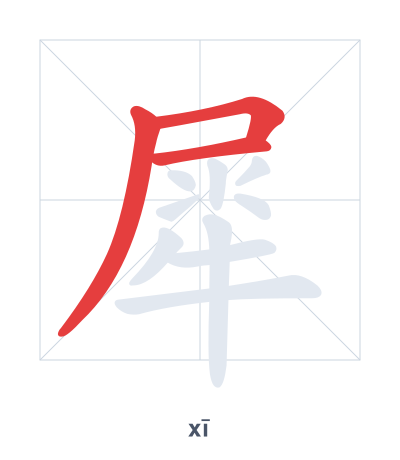
Open Hanzi Writer to see the animated stroke order and practice writing 犀 with real-time feedback.
The character 犀 (xī) is written with 12 strokes. Follow the standard Chinese stroke order: top to bottom, left to right, outside before inside. The radical 尸 is one of its key components.
Practice the correct stroke order with the Hanzi Writer app to see animated stroke-by-stroke guidance with real-time feedback.
犀 means rhinoceros; sharp.
Originally a pictograph of a rhinoceros with a prominent horn, the modern form combines 尸 (body/hide), 牛 (ox), and 辛 (knife) to emphasize the animal's thick skin and sharp horn.
💡 Memory Tip: Picture a rhinoceros with a sharp cross-shaped horn (辛) piercing out from its leathery body (尸) on four cow-like legs (牛).
动物园里有一头大犀牛。
dòng wù yuán lǐ yǒu yī tóu dà xī niú
There is a big rhinoceros in the zoo.
他的眼神非常犀利。
tā de yǎn shén fēi cháng xī lì
His gaze is very sharp.
我们两人心有灵犀。
wǒ men liǎng rén xīn yǒu líng xī
The two of us are on the same wavelength.
Open Hanzi Writer to see the animated stroke order and practice writing 犀 with real-time feedback.
✨ Animated stroke order · Handwriting recognition · HSK-graded practice · Free to use
犀 is made of 尸 (corpse) on top and 牛 (cow) at the bottom, but here 尸 is a phonetic clue rather than meaning corpse. The part 牛 shows the animal category, while the overall shape suggests a strong, sharp-horned creature like a rhinoceros.