屐 (jī) means "Clogs; wooden shoes." in Chinese. It has 10 strokes with the radical 尸.
Rated 4.2/5 in difficulty (advanced).
Appears in 3+ common words including 木屐 (mù jī), 草屐 (cǎo jī), 屐痕 (jī hén).
Due to its 10 strokes, Hanzi Writer's error detection shows 屐 requires focused practice — most learners need 10+ attempts for consistent accuracy.
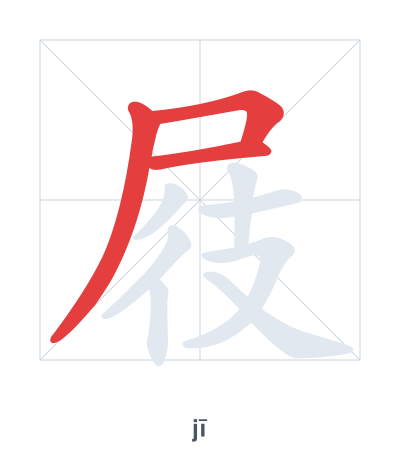
Open Hanzi Writer to see the animated stroke order and practice writing 屐 with real-time feedback.
The character 屐 (jī) is written with 10 strokes. Follow the standard Chinese stroke order: top to bottom, left to right, outside before inside. The radical 尸 is one of its key components.
Practice the correct stroke order with the Hanzi Writer app to see animated stroke-by-stroke guidance with real-time feedback.
屐 means Clogs; wooden shoes..
屐 is a phono-semantic compound. The radical 尸 is a simplified form of 履 (shoe), indicating footwear. The component 支 (zhī) provides phonetic cues and also visually suggests a wooden support, like the sole of a clog.
💡 Memory Tip: Picture a corpse (尸) standing on two wooden sticks (支) — those are its clogs!
他穿着木屐走路。
tā chuān zhe mù jī zǒu lù
He is walking in wooden clogs.
古人常穿草屐。
gǔ rén cháng chuān cǎo jī
Ancient people often wore straw sandals.
地上留下了木屐的痕迹。
dì shàng liú xià le mù jī de hén jì
The ground bears the marks of wooden clogs.
Open Hanzi Writer to see the animated stroke order and practice writing 屐 with real-time feedback.
✨ Animated stroke order · Handwriting recognition · HSK-graded practice · Free to use
屐 is composed of the radical 尸 (corpse or body) on top and the phonetic component 支 (zhī) below. The radical 尸 is used here to indicate something related to the body or feet, while 支 hints at the pronunciation. Together, they represent a type of footwear: wooden clogs worn on the feet.